Tuesday, September 05, 2006

Autumn Reading Challenge


I've wandered far afield in recent months from my pledge to keep track of what I'm reading via this blog. Some of it is due to lack of discipline, but more of it is due to the fact that life's been so busy that this has become, in the main, more of a general journal than I ever expected it to. As much as I love books, life is full of other experiences too, many of which I enjoy "reading" (or letting read me!) and reflecting on!

I do plan to do some sort of a round-up to reflect a bit on what I've been reading in recent months. Until then, however, I thought I would challenge myself with the "Autumn Reading Challenge" found at a blog called "Seasonal Soundings."

I'm sure I'll tweak this list a bit -- because I tend to follow fairytale breadcrumb trails from book to book, I often end up reading lots of things I didn't plan to read. But here's at least some of what I'm challenging myself with in the coming autumn months (and perhaps a bit of the winter too).

The Irrestible Revolution by Shane Claiborne (I'm part-way through this and want to finish it)

I just started Jim Wight’s biography of his dad The Real James Herriot and also James Herriot’s Yorkshire.

Oliver Twist by Charles Dickens. Because I've never read it, and I promised myself after reading A Tale of Two Cities (last summer) that I would read more Dickens!

Miniatures and Morals – The Christian Novels of Jane Austen by Peter Leithart (this has been on my wishlist forever; haven't been able to get it via library and can't afford to buy it...but if I can find a copy, by golly, I plan to read it!)

Essays from Love’s Redeeming Work: The Anglican Quest for Holiness compiled by Rowell, Stevenson and Williams; and Glorious Companions: Five Centuries of Anglican Spirituality bu Richard Schmidt. These are both on the reading list for a course called Anglican Way of Theology, which I'm being allowed to sit in on as an online guest. I consider this enrichment reading which will help me in the course I'm teaching online (Episcopal Ethos).

I've decided to revisit Robert Frost this fall; my favorite edition of the poems has Louis Untermeyer's intro. and notes. I have favorites in that collection that I've read over and over, but I'm not sure I've ever attempted a read-through of all the poems in it from start to finish. I started last night right before bed.

I'm also adding the following to my list: The Sense of the Call - A Sabbath Way of Life for those who serve God, the Church, and the World, by Marva Dawn. I really like her work and I think this book might be very appropriate for this season of our family's life. I'm hoping the seminary library has a copy or I can get it via loan!

Historic Parallels: Rauschenbusch and Cabrini?

Books and Culture's e-letter today contained a review by Philip Jenkins, author of The Next Christendom. Jenkins, with his emphasis on Christianity as a global movement, is always fascinating and thought-provoking.

I've had an exhausting day and am still wending my way through his review of the new, multi-volumed (some still in process) Cambridge History of Christianity but this little bit struck me as especially interesting food for thought:

Equally, Christian movements and trends often transcend the boundaries between Protestant, Catholic, and Orthodox, though this fact is lost when movements are studied in isolation. In the 1670s, for instance, German Protestantism was transformed by the Pietist movement, which stressed personal devotion and heart-religion in a tradition that overemphasized clericalism and scholarship. At exactly the same time, Roman Catholic mystics elevated the devotion to the Sacred Heart of Jesus.

Protestant-Catholic parallels and connections emerge time and again in the chc volume on the 19th century, inevitably since the various countries were dealing with similar political issues in the aftermath of the European revolutions, and to varying degrees were experiencing modernization and industrialization. In response, Protestants, Catholics, and (later) Orthodox formulated innovative strategies and evolved similar responses—fideistic and devotional movements, missionary enthusiasm, calls for moral purity. The well-known feminization and domestication of Victorian Protestantism finds a close parallel in the complex of Marian devotions in contemporary Europe.


This seems like an obvious "duh" observation, but to my tired mind it seemed pretty profound. We do tend to study movements, especially denominational/sectarian ones, in isolation. I have spent some time studying the Pietist movement, for instance, and I've got more than a passing familiarity with Catholic devotion to the Sacred Heart (since I spent almost five years working for the Missionary Sisters of the Sacred Heart of Jesus) but I don't think I ever thought to connect their roots/beginnings. Worth exploring I should think.

I do wonder how often this is true in Christian history...the church, in its varied forms and traditions, responds to key cultural and world events, and those responses naturally look different, coming as they do from such diverse traditions, but perhaps share a deeper core than the traditions might realize.

I am thinking, of course, of my own personal favorite historic era in American history -- the early 1900s, specifically prior to 1925. I've spent a lot of time in company with two almost larger than life religious figures from that era: Walter Rauschenbusch, male, Protestant, Baptist, father of the Social Gospel (about whom I wrote my thesis) and Frances Xavier Cabrini, female, Catholic, Roman, founder of the Missionary Sisters of the Sacred Heart (and about whom I wrote an essay, among other things). On the surface, they were seemingly very different people, but I've often wondered what interesting comparisons might surface if one pushed a bit at their unique responses, as missioners/missionaries especially, to the effects of industrialization in America. Both had a real heart for the poor, though I think all in all Cabrini's activism was more vital (and more theologically healthy) and her legacy more long-lasting. Rauschenbusch's Victorian sensibilities about the family and Cabrini's Marian devotion both seem to be a part of the overarching climate Jenkins' references too.

I need to think more about this.

Wednesday, August 30, 2006

A Four Year Old's Questions

Lately the sweet girl has been a veritable fount of questions. They come faster than I or her Dad can answer them. "Why?" "How come?" "What if?" are her especial favorites.

Sometimes it's exasperating, but sometimes it's also precious and funny -- and more often than not, I'm in awe of her insatiable curiosity.

She comes up with some good ones too.

The other evening we had our atlas out, looking up countries from our prayer calendar. We've done this for a couple of years and the child loves maps. This time around we happened to be looking at Europe, and down at the very bottom of the map, not far under Greece, you could just see the beginning of Turkey. We were naming all the countries and when we got to Turkey she looked very thoughtful and then asked with a giggle "Are there any turkeys in turkey?" A very good question, especially considering we'd just seen wild turkeys at the zoo! This question got such a chuckle out of both D. and me that she's been asking it with increasing giggles in the days since -- she's figured out it's funny.

Then there was the other night at dinner. We were eating peas and corn and all she wanted to talk about was how they grew. Corn grows on cobs and peas in pods. We talked about this for quite a while, and then she wanted to know why we didn't eat the peas in their pods. "Sometimes we do," I said. "Remember snow peas?" She paused, then asked in her planitive little voice, "What color are snow peas?" With some surprise (because I thought she remembered them) I said "They're green, sweetie. Just like regular peas." Another pause. Then: "Why aren't snow peas white like snow?"

Yet another good question!

She's also been on a kick lately about height. She's been wondering if people grow and grow their whole lives, and we've been trying to explain that people only grow to be so tall and then stop (usually somewhere between 15 and 20). We've explained that people keep growing in other ways, but they don't just keep getting taller. (If I didn't know she couldn't read yet, I'd be worried that she'd been reading science fiction by Orson Scott Card...) But this is still a tough concept for her grasp. The other day she kept worrying at it like a dog with a bone. "What if we got to be 100?" she asked doggedly, and I said, "well, some people do live to be 100. They're very old." -- "But would they be really, really tall?" she persisted. I do think she's starting to get it though. This morning, sitting in her room in her little Sleeping Beauty nightgown (her new haircut making her look oh so grown up) she suddenly glanced over at D. and said "is Daddy as tall as he's gonna get?" :-)

Of course, it's not all curious questions. Sometimes it's just interesting observations. I love some of these most of all, especially for their totally "out of the blue" quality. Like this morning at breakfast, as she sat there spooning her cereal, and suddenly announced: "Lions don't roar really well when they have hiccups."

You know, that's probably true. And thanks to my sweet girl, I think I have the genesis of a new story!

Sunday, August 27, 2006

Are You Blue Too?

You Are a Blue Flower

A blue flower tends to represent peace, openness, and balance.
At times, you are very delicate like a cornflower.
And at other times, you are wise like an iris.
And more than you wish, you're a little cold, like a blue hydrangea.


I took this quiz the other day and decided then not to post the results because I wasn't sure how I felt about being a blue flower. It sounded so...melancholy.

Then today I had an email from my oldest sis, who's getting married in just a couple of weeks. She was asking my advice on flowers to go with her light blue dress. I got to thinking about flowers...including all the bluish flowers I love (especially delphiniums and irises) and then I spent a while online looking up more blue flowers, and you know what? There are some lovely ones. Cornflowers, for instance. And phlox, and bluish (well, lavender at any rate) roses. Put any of these together with some creamy whites or blush pinks, and you've got a beautiful bouquet...

I even like hydrangeas. Yes, I do! I don't think they're cold at all, although they do bloom in "snowball" kinds of clumps.

Turns out I don't mind being a little blue after all. Are you blue too?

"Something Tells Me It's All Happenin' At the Zoo"

"A thing may be too sad to be believed or too wicked to be believed or too good to be believed; but it cannot be too absurd to be believed in this planet of frogs and elephants, of crocodiles and cuttle-fish."
~~ G.K. Chesterton


Amen to that! We spent much of yesterday at the Pittsburgh Zoo and PPG Aquarium downtown. We've had no vacation time at all this summer, and I think every one of us in the family is feeling that loss. So D. and I decided we should at least try to get in one or two short "family outings" of the day trip variety before fall fully arrives. The sweet girl has been longing for the zoo (as well as the beach, and a yard, and her grandparents, and a tricycle...but hey, we can't do much about the rest of those right now, so off to the zoo we went!).

Every time I visit the zoo -- and I think this was the third time in four years -- I come away more amazed than ever by the creativity and sheer diversity of creation. To know that we're looking at just a tiny sliver of what's out there, and to see such a plethora of interesting, odd, funny, beautiful and sometimes downright absurd looking animals and fish (not to mention plants) is breathtaking. I love the Chesterton quote above, and it's particularly apt for yesterday as we spent time gawking at both crocodiles and elephants.

The crocodiles were four of the "dwarf" variety. At first I thought they were babies, but the sign next to their enclosure read "dwarf crocodiles" so I guess they were full size. They were just a few feet long, but oh so menacing. Two of them sunned lazily in the water, their bodies mostly submerged and their heads and eyes protruding just above the surface. The other two lay on the banks; one was asleep but the other had his jaws wide open and his listless hooded eyes never blinked. They were both so still you couldn't see them breathe. They looked like bronze statues. People beside me were wondering if they were real at first, and after a while I think most of us felt a combination of eerie admiration and thankfulness that there was a concrete wall between us and the water. I got the distinct impression that the jaws and eyes wide open crocodile was trying to bluff us all so he could find a way to lure us in. Kind of bizarre.

The elephants were something else again. There were a few outside we got to watch, but then we got to see two of them close up in an enclosure. We watched them eat their dinner (well, my daughter insisted it was still afternoon so they were having lunch) and those long, sweeping trunks, so leathery and wrinkled and yet so elegant and almost delicate in their sniffing, shuffling and lifting, were a wonder to behold. The biggest elephant was really hungry; we watched him sniff out and sweep up a large pile of "salad" on the floor of the pen, mostly apples, carrots and lettuce. His nose would sniffle along, oh so delicately, find what it wanted, and then curl around it and swirl it up to his mouth (often a whole head of lettuce at a time!) just as elegantly and fastidiously as an experienced diner might swirl spaghetti on the tines of a fork.

A lovely day. Even though my back is still aching from all the walking we did!

Thursday, August 24, 2006

"Step by Step"

Oh God, You are my God
And I will ever praise You
Oh God, You are my God
And I will ever praise You

I will seek You in the morning
And I will learn to walk in Your ways
And step by step You'll lead me
And I will follow You all of my days

--Rich Mullins

Monday, August 21, 2006

"Tearipifymome"

No, you're not seeing things. You have probably never heard of the word "tearipifymome" because it wasn't a word until this afternoon, when the sweet girl and I invented it.

We were playing with refrigerator magnets, and it started out as a quick phonics lesson in the middle of dinner-time preparations. "T" followed by "E" -- "what word does that make?" my daughter asked. I explained that it didn't make a word exactly, but that we could still sound it out and see what sounds the letters made together. So we did. Then I added an "a" to make the word "tea" (she loves to drink tea) and an "r" to show her how to make the word "tear." And the next thing I knew she was pulling letters at random, adding them to the end, and asking "what does it sound like now?" Before you could blink, we'd built a long, skinny bridge of letters more than half-way across the refrigerator and we both had the giggles.

And we ended up with a humdinger: "tearipifymome." I'm pronouncing it thus: "tear-ih-PIF-ee--mohme."

My dear husband got a big kick out of this when he got home. We told him we'd made up a word, and sweet girl kept repeating it with great gusto (and more giggles!). But I confessed we'd not yet decided what our new word should mean. D. decided it sounded like a poetic device. As in: "if you can use tearipifymome, you can write good poetry." Hmmm. Maybe so.

I sure hope I'm not mixing up sweet girl too much before we get to official reading lessons. :-) Which, I might add, I'm hoping to start trying soon. I've just about decided on using Teach Your Child to Read in 100 Easy Lessons. I've been trying to establish a light-moderate homemade homeschooling curriculum to use in conjunction with her two days of preschool per week this fall. I know my time will be extremely limited, given the fact that I'm still having to work mornings and I'm also teaching online again for the seminary. But I'm still getting excited about schooling possibilities and want to do what I can (without making any of us too crazy).

Monday, August 14, 2006

On the Writing Front

Rats. I just got word today that a magazine that had held a story of mine for possible publication has decided not to use it. They returned it with a nice note, told me how much they liked it, and even suggested I try re-submitting it next year once I've checked their theme list in case I think it might fit with any of those themes. All very kind, and I'm grateful for all encouragement, but I'm feeling a bit discouraged right now because I seem to get these kinds of notes from editors a lot -- we like it, but we don't quite like it enough, or we don't think it quite fits what we're trying to do.

This seemed like particularly hard timing because I'm actually submitting -- ironically enough, TODAY -- another story to this same magazine. Their fiction contest is closing out tomorrow so I have to get the story postmarked this afternoon. It's ready to go; as soon as sweet girl gets up from her nap we shall head over to the post office. But now I'm feeling kind of hesitant about sending the story. I had been thinking I should definitey submit again to the contest this year, since I got such positive feedback from the editor last year (in addition to holding on to it for possible publication, they told me it finished in the top ten among 400 entries). I know I should "strike while the iron is hot" so to speak, and keep my work out there, in front of people -- especially people who tell me they like it. I never intended to wait this long and cut the deadline so close, but between busyness and computer woes, and then a yukky case of writer's block with the first attempt (a story that I finally gave up on, after deciding it was probably more of a picture book than a short story for a magazine) I'm really glad I managed to get anything done for it at all. So I should probably go on and send.

But I'm not sure it's as good as last year's. At least my heart doesn't feel like it is. Maybe I'm just tired.

Anyway, all I can do is keep trying, keep writing in the cracks and crevices of a life that sometimes feels so full that writing could easily get squeezed out completely if I didn't keep on pushing. So push on I will. I have the rough notes of an essay ready to work up for a submission soon, and I'm working on a set of poems for another submission. I got a lovely note back from someone at Eerdmans in reply to my oh so confident inquiry and they're actually going to send me a free review copy of one of their new kids' books so I can review it on Epinions! It feels like it takes chutzpah for me to sell myself as a reviewer, but I love review work and think I've gotten much better at it in the past two years. Wish I could get a journal or newspaper to agree...

Enough whining. :-) My class starts soon, and I really need to rewrite my opening lecture. I know once I'm teaching again, I will likely find even less time to give to any other kinds of writing until the semester is over. So I'll keep on while I can. I'm grateful, I really am, for every inch of writing life I can enjoy. And I'm going to keep on trying. On to the post office!

Wednesday, August 09, 2006

The Wisdom of a Ragamuffin

I recently placed an order with Christian Book Distributors for a book I'm hoping to utilize with my sweet girl during some schooling times this coming fall (more on that soon...I need to do a bit of reflecting and "thinking out loud" about some terrific homeschooling resources). I ordered that book and one other that D. and I had both been wanting to get, and then I did something that perhaps no bibliophile should do...especially not one as broke as I am. I actively looked for bargains. CBD will sometimes throw books into their bargain bin that I think are incredible finds for just a couple of dollars. And I struck gold (per usual) this time with a small, hardback copy of reflections by the late songwriter Rich Mullins.


If you knew Rich Mullins' name early on in his career (in the 80s) you probably knew it in the small type of the liner notes on Amy Grant's albums. I think I first noticed his name as the writer of "Sing Your Praise to the Lord" on her 1983 album "Age to Age." He also penned other songs she sang, including one of my very favorite songs from the album "Straight Ahead," a ballad entitled "Doubly Good to You." But Rich really came into his own as a singer and songwriter in the late 80s, early 90s. He wrote a couple of songs that became standards in Protestant evangelical worship, including "Awesome God" (which has a very catchy chorus but otherwise is not, I don't think, a very good example of his usually excellent songwriting skills...though perhaps his skills deepened as he aged) and "Step by Step."

I love so much of his work, but the albums that have spoken the most to me over the years are "Winds of Heaven, Stuff of Earth" (1988, and the first of his albums I ever owned); "A Liturgy, A Legacy and a Ragamuffin Band (1993, and a CD I fear that I will actually wear out one of these days); and finally, "The Jesus Record" (a posthumous recording of the last songs he ever wrote -- one CD contains the homemade demos of the songs as he performed them, and the other CD contains the songs arranged and produced by his bandmembers and performed by many people who loved him, missed him and wanted to pay him tribute). One day I would like to spend some time writing more about the songs on "The Jesus Record" because so many of them have worked like contemporary Psalms in my life, speaking my ragged heart in times of struggle and difficulty.

But today I just wanted to note how lovely it is to be reading some of Mullins' written reflections, captured in this little book The World As I Remember It: Through the Eyes of a Ragamuffin. It's primarily a compilation of some columns he wrote for a magazine in the early 90s. The book itself, published by Multnomah, is beautifully designed...small and easy to hold, with sepia toned pages that almost look as though they've been dipped in steeping tea, and full of gorgeous sepia toned photographs by Ben Pearson, a close friend of Rich Mullins. Many of the photos are of Mullins himself, and while I wonder how he'd feel about that, since he was not one to crave the limelight, the photos are such a creative and beautiful study of one man's varying expressions through seasons of life that it's hard not to enjoy them.

Rich was a simple soul, and yet "rich" as his name indicated, rich in the things that mattered most, especially love of God and life in Christ. Just a couple of years before he died at the age of 41 (in a 1997 car accident) he'd moved to a Navajo reservation in Arizona to teach music to children. Although he was an amazing artist -- a good musician and most of all, a fine poet -- clearly the center of his life was not art but God. He practiced art not for the sake of art, but art as an expression of his love for God and his love for the life God had given him.

All of his reflections here are thoughtful and worth chewing on, and I will continue to meditate on them as I go. Some seem especially poignant in light of the fact the he died just a few years after writing the words. Lines like:

"Someday I will rise up like the sun in the morning -- someday I will shine like the saints who watch from cathedral windows. I know this, not because of any evidence I have produced of myself, but because of the witness of His Scriptures, because of the evidence of His grace, and because of the testimony of this sky that washes over me at dusk."

And here's another favorite quote thus far:

"Faith is not a denial of facts -- it is a broadening of focus. It does not deny the hardness of guitar strings, it plucks them into a sweetness of sound."

Sunday, August 06, 2006

Feast of the Transfiguration

"The all-important thing about this glorious feast is that it marks the point in time when three of the disciples, for a millioneth of a second, saw Jesus as he really was."

-- Canon Edward Nason West

As he really was. All the time. Remember how Moses had to veil his face after he'd been in the Presence? Because people couldn't bear the shining. How much more did Jesus have to "tone down" the glory, and only let it shine forth in flashes, fragments, glimpses here and there, when He walked the earth? He knew what his followers were ready for. He knew how much they could bear to see revealed. What a joy it must have been for Jesus, for just one brief moment on that earthly mountain, to hold nothing back, to shine forth in the fullness of his eternal glory! Even though it left the disciples dumbstruck, except for stammering Peter who gasped out the first words that came into his head...

And John. I think John must've remembered this moment, its incredible shining beautiful clarity, when he looked upon Jesus on the cross. I think perhaps John might have realized that he was seeing it again, the fullness of the glory, revealed this time not in light but in suffering.

Friday, August 04, 2006

Please Go On and Grieve Dumbledore's Death

I've been working on a new Harry Potter posting, still in my draft folder, in which I'd begun to tackle the final three Harry confrontations I wanted to reflect on, namely Harry's potential meetings with Neville, Dumbledore, and Snape in book 7. I had planned to take them on in that order, but JK Rowling's recent comments about Dumbledore have compelled me to deal with the topic of Harry and Dumbledore first.

You'll note if you look back at my last posting that I put several question marks after Dumbledore's name and also said "stay tuned." That's because I knew it must have seemed strange for me to discuss the potential "meeting" of Harry and Dumbledore in book 7 when Dumbledore had died at the end of book 6.

And I have always believed that Dumbledore was really dead. It didn't take JK Rowling announcing it at a major public event to bring the reality home. Do I believe that there was more going on than immediately met the eye in that final tower scene? Yes. Do I believe there is still much to be revealed regarding the manner and method of Dumbledore's death and the circumstances surrounding it? You bet. But in part because so much of the Harry Potter stories have centered on the reality of death and loss, and on the proper way to grieve such losses in our lives, I did not think that Rowling was attempting to fool us here with a fake death, especially not of such a major and beloved character. Besides which, Dumbledore's death, difficult as it was (and I cried all the way through it) made both symbolic and narrative (plot) sense.

My feelings that Harry will yet "meet" Dumbledore in some form stem from the fact that Rowling's rich, imaginative setting provides at least two provocative ways in which that could happen. One is through the portrait now in the headmaster's office (you'll remember that Dumbledore's portrait joined the ranks of the other late headmasters and headmistresses at the end of HBP) which, while not fully Dumbledore, at least will be some form of Dumbledore's personality able to communicate, help and perhaps counsel. I don't think it's clear that the portraits can do that fully for anyone but the current headmaster or headmistress, which could lead us to believe that only Minerva McGonagall may have full access to its advice, but Harry's certainly been present plenty of times when the other portraits have spoken and acted.

The second more fascinating idea is that Harry may yet meet Dumbledore through memories in the pensieve, either his own memories or (and this is what I hope) memories Dumbledore has left behind him on purpose, in order that Harry might access them. Can memories be stored for a long time? Or do they die (fade?) with the one who holds them? I'm not sure we know, but I hope we find out.

(Note: we do know that Tom Riddle managed to preserve a rather powerful memory for a very long time, but that he did it through a horcrux, which Dumbledore, though smart enough to figure out, would never have done. We know Dumbledore held a lot of powerful skills in check because he was "too noble" as McGonagall once put it, to do otherwise. What I'm thinking of specifically here is how pensieve memories work. We know that they can be placed in a container and can exist without their owner being in close proximity -- witness Snape leaving some of his memories in the classroom, which Harry found and entered without permission -- but what I don't think we know for certain is whether or not pensieve memories can exist after the person who held the original memory is dead, or whether or not they can be willed to someone.)

Beyond those kinds of potential "meetings," I think there are other ways in which Dumbledore may have left Harry help. First, there's the deep reality of all the loving, protecting, mentoring and teaching Dumbledore has provided Harry for sixteen years. There are the many wise words, and words of advice (including some we and Harry may not have realized were important) that will surely come back to Harry when he most needs them. Harry already feels he's "Dumbledore's man" and I think we'll see him grow into that more and more as book 7 progresses. And finally, there are the potential helpers and protectors Dumbledore has perhaps left Harry, most notably Hagrid, Fawkes...and Severus Snape. Yep, I'm sticking by that! I still think Dumbledore and Snape have managed, between them, to place Snape right where he needs to be to be the most help to Harry. More on this in the Harry meets Snape posting I still plan to do.

I would like to muse for a couple more minutes on what Rowling just recently said about Dumbledore. As I've mentioned before, her interviews and appearances are so rare that it's especially noteworthy when she goes on record. In this case, she was doing a reading for charity at Radio City Music Hall, along with Stephen King and John Irving (now there's an interesting trio!) and fielded questions from the audience. I'll excerpt a bit from Publisher's Weekly round-up of the event:

A few of her answers yielded new information. In reply to a question from surprise guest Salman Rushdie and his nine-year-old son that involved an elaborate theory about how Professor Dumbledore comes back to life in Book 7, Rowling said, "I feel I have to be explicit. Dumbledore is definitely dead. You shouldn't expect Dumbledore to pull a Gandalf." A cry immediately erupted from the crowd, to which she commented, "All of you definitely need to move through the five stages of grief and get past his death." She added that she'd heard about a Web site, dumbledoreisnotdead.com, which is devoted to conjecture similar to Rushdie's theory, and said, "I imagine they aren't happy right now."

***********************************************************************

Let's note three interesting things.

1- She was really explicit. By confirming the obvious, she cut off fruitless speculation in certain directions but opened up, I think, avenues for speculation in even more intriguing directions.

Because I do empathize with those readers who have been going round and round trying to read the "clues" of Dumbledore's death scene to figure out why it doesn't seem to "play straight." They've picked up on something very important about JK Rowling's writing style, that she will subtly lead you in one direction while appearing to lead you in another. I don't think the gut instinct to probe the surface of that heart-wrenching scene is crazy. And with JKR's insistence that Dumbledore is truly dead, readers should now be free to probe in different directions. If it's not the reality of Dumbledore's death that should be called into question, what else should be? How about the manner of his death? Snape's role in it? The words surrounding it? The reason for it? All of those things, it seems to me, are far more interesting roads to pursue.

2- Rowling suggested, perhaps somewhat gently and jokingly (I haven't heard the comment on audio, so am guessing as to tone) that her readers need to grieve Dumbledore's death. I don't think this is an accident, or a mean way for her to say "get over it already." I think she's serious here. She's never made a secret that the HP stories are about death and how we grieve death. She's never shied away from its reality, in real life or in the stories. She's never promised she won't kill off Harry, our hero. She's never pulled any punches and suggested that magic can fix everything, make everyone happy, or bring characters back to life. It doesn't work that way in Rowling's fictional universe.

These stories she's written have helped many people, young and old, face the realities of grief and loss, in part because we've lived through such deep losses with characters we've come to love and care about. The fact that so many of her readers are in steadfast denial about Dumbledore's death may trouble her, I think. Although her stories are not primarily didactic, they do teach, and some of the things she's been trying to teach is that death is not the worst thing that can happen to someone, and that we can grieve fully and go on living and loving even in the wake of terrible heart-wrenching loss. Her reminder to grieve the death of Dumbledore may be a reminder to go back to the stories themselves and read them again to see what she's been saying all along.

3 - "You shouldn't expect Dumbledore to pull a Gandalf." My heart leapt here. I love the fact that she can reference Tolkien so casually and expect people to know exactly what she means. I know some of this is due in part to the LOTR films, but I also know plenty of people who might not have known Tolkien's books otherwise and discovered them through the movies. JKR is not Tolkien -- that's one of the things she seems to be saying -- but she knows people are comparing them, and she knows she walks in his giant footsteps. Dumbledore won't pull a Gandalf, but the two of them are literary brothers and she's had to shape his character and her plot in the shadow of Tolkien. Though she's not an Inkling (perhaps a post-Inkling?) she's plowing much of the same ground as she writes stories that echo the Great Story, as so many of us were originally helped to see by John Granger's fine work on HP.

I love that at the beginning of the 21st century our narrative starved culture is embracing Rowling, and re-embracing Tolkien and Lewis with such ardor. It gives me hope!!

And of course, now I want to know...will Wormtail pull a Gollum?

Wednesday, August 02, 2006

The Little Town of Why

I recently posted a tale from the land of language acquisition. It's a fine land where our family spends a lot of time these days since we have a bright and inquisitive four year old who has inherited our love for language.

The little town of Why is pretty centrally located in this land. It's in a green valley surrounded by misty hills. Hang a left at the stone of "how come?" and push past the forest of "what would happen if..." and you're there. You'll recognize the place by the incessant buzzing-whining sound of "why why why why?" It seems that questions, like bees, can pollinate and make things grow and bloom.

My dear husband has had a lot of evening meetings lately, which means that Sweet Girl and I have had a lot of dinners with just the two of us...well, three, counting her worn bear Trumpkin. Trumpkin was the lovely brown bear I took with me to college (a gift from my Dad). I had no idea he would come out of retirement so many years later and become my daughter's bear. He's about 20 now, and definitely looking a bit thin these days, especially since he's been pulled, prodded, smushed and slept on for the last two years, and dressed and re-dressed in numerous baby clothes for the last two months. He often sits on a little stool right next to my daughter's chair at the kitchen table, looking on at the proceedings with his shiny brown eyes. I have a feeling he's muffling laughter when he hears exchanges like this evening's:

Sweet Girl: Why are we having corn?

Mommy: Because we like it.

Sweet Girl: Why do we like it?

Mommy: (slurping butter off the cob) Because it tastes yummy.

Sweet Girl: (scandalized by slurping) Why am I getting corn all over my face?

Mommy: Sometimes that happens when you eat corn.

Sweet Girl: Why does it taste yummy?

Mommy: Because that's how God made it.

A pause....

Sweet Girl: What would happen if we ate the cob?

And I was sure I'd be some kind of chocolate!

What Kind of Ice Cream Are You? A friend had this silly quiz up on her blog, and I thought I'd take the quiz myself and post the results. Here they are. If it's as hot where you are as it is here (whew!) you may want to take it too!

Who knew I'd turn out to be strawberry??!


You Are Strawberry Ice Cream
A bit shy and sensitive, you are sweet to the core.You often find yourself on the outside looking in.Insightful and pensive, you really understand how the world works.
You are most compatible with chocolate chip ice cream.

What Flavor Ice Cream Are You?

Power Made Perfect in Weakness

I've been reading Anthony Bloom's book Beginning to Pray. This morning I came across these words about weakness, and how God's power can be manifested, made perfect, in our weakness:

Bloom writes:

"Weakness is not the kind of weakness which we show by sinning and forgetting God, but the kind of weakness which means being completely supple, completely transparent, completely abandoned in the hands of God. We usually try to be strong and we prevent God from manifesting his power.

You remember how you were taught to write when you were small. Your mother put a pencil in your hand, took your hand in hers and began to move it. Since you did not know at all what she meant to do, you left your hand completely free in hers. This is what I mean by the power of God being manifest in weakness. You could think of that also in the terms of a sail. A sail can catch the wind and be used to manoeuvre a boat only because it is so frail. If instead of a sail you put a solid board, it would not work; it is the weakness of the sail that makes it sensitive to the wind."

May I be a child learning to write. May I be a pliable sail.

Wednesday, July 26, 2006

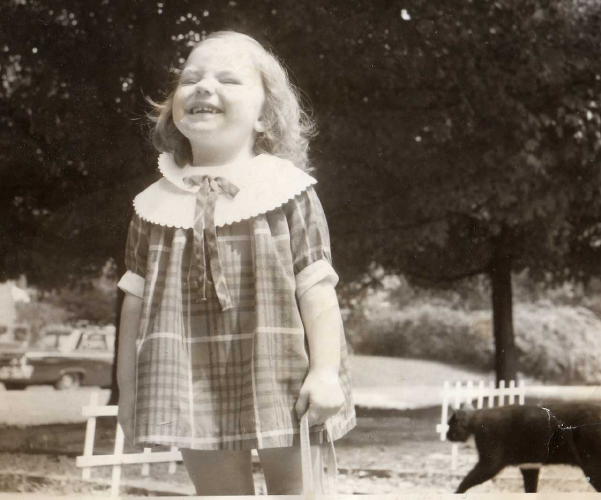
Me at Three


I've been trying to get up my courage to post a photo of myself -- here and also over at Epinions, where I write book reviews. I've been thinking I might use this one, which is one of my favorites of all time. It was taken by my older sister when I was three and she was about nine. And I think it captures the joy I felt about just about everything at the time!

It also gives me insight into my own daughter, newly turned four.

Also love it because in the background you can see (just barely) our old family cat, Harvey. He was a member of the family before I was born, and lived until I was thirteen. He and I especially bonded in his old age. He was a very precious and tenacious kitty.

Tuesday, July 25, 2006

Putting Myself in the "Naughty Chair" (Read on...It Will Make Sense!)

For years I've been an ardent fan of the Betsy-Tacy books by Maud Hart Lovelace. These are wonderful stories, ten in all, about a girl named Betsy Ray. Betsy grew up around the turn of the 20th century in the small town of Deep Valley, MN and was based on Maud Hart Lovelace herself as a girl growing up in Mankato.

Some day I will do more writing about these wonderful books and why I love them, but for now, let me just reference one of my favorite parts of the tenth and final book, Betsy's Wedding. In this book, Betsy Ray marries her high school sweetheart, that dashing newspaperman Joe Willard. Joe was based on Maud's husband Delos Lovelace, and both Maud and Delos (and by extension their fictional counterparts Betsy and Joe) were writers.

In Betsy's Wedding, set around the time of WWI, the two of them are regular attenders of a wacky and loveable group of writers. The group dubbed itself "The Violent Study Club" and besides reading to each other from books they loved, they would read snippets of writing they were working on and ask for encouragement and criticism. I've always wished, quite wistfully, that I could find a group of writers as vital and fun as the Violent Study Club.

One of their most loveable quirks was putting a member of the group in a special seat called the "naughty chair" whenever one of them got published. This always made me laugh. Since they were all struggling writers, it was their way of saying "well done!" and providing recognition, and of laughingly chiding the published writer for showing the rest of them up by actually daring to go out and get something published.

With life being what it is these days, crammed full to bursting with so much to do (and so many things I wish I could do more wholly and fully) I'm not getting much of a chance to send work out. So when I do, and when I get a positive response... and an actual by-line...it feels worth celebrating.

I don't have a "Violent Study Club" (more's the pity) but every once in a while, when I get something published, I'm going to put myself in a figurative (virtual?!) naughty chair, because even small writing accomplishments are worth celebrating.

My essay "All That Is Gold Does Not Glitter" came out this past week in the "Literary Heroes" issue of Inkblots, a lovely, small and independent literary magazine edited by Melinda Lavorante. You can go here to see the publications's website and a copy of the cover of the issue: www.erality.com/inkblots/page.php?summer06

Melinda is an excellent and encouraging editor and I appreciate the way she mentors younger writers...and doesn't mind accepting submissions from more seasoned (read: middle-aged) folks like me as well. I've already recommended her lovely publication to a talented young writer I know who is still in high school, and I'll continue to pass the word along to other writers as well as interested readers. If you love good books, especially literary classics, this magazine is an enjoyable read!

Monday, July 24, 2006

"Hold Me, Jesus..."

My four year old daughter has fallen in love with Rich Mullins' CD "A Liturgy, A Legacy and a Ragamuffin Band." Her favorite song (which is also mine, go figure!) :-) is "The Color Green." We've been dancing to it a lot. So celtic and lovely. A marvelous song of praise and celebration!

I love the whole album though, and tonight the only song that keeps running through my mind is the beautiful, prayerful "Hold Me, Jesus." Sometimes I just need to hear and pray what it says. I post it here in case anyone else needs to hear and pray it too.

"Hold Me, Jesus"

(Rich Mullins)

Well, sometimes my life
Just don't make sense at all
When the mountains look so big
And my faith just seems so small

CHORUS:
So hold me Jesus, 'cause I'm shaking like a leaf
You have been King of my glory
Won't You be my Prince of Peace

And I wake up in the night and feel the dark
It's so hot inside my soul
I swear there must be blisters on my heart

CHORUS
So hold me Jesus, 'cause I'm shaking like a leaf
You have been King of my glory
Won't You be my Prince of Peace

Surrender don't come natural to me
I'd rather fight You for something
I don't really want
Than to take what You give that I need
And I've beat my head against so many walls
Now I'm falling down, I'm falling on my knees

And this Salvation Army band
Is playing this hymn
And Your grace rings out so deep
It makes my resistance seem so thin

CHORUS
So hold me Jesus, 'cause I'm shaking like a leaf
You have been King of my glory
Won't You be my Prince of Peace

You have been King of my glory
Won't You be my Prince of Peace

Thursday, July 20, 2006

HP Book 7: More Final Confrontations for Harry

In my last HP post I focused exclusively on Harry's final confrontation with Voldemort. Clearly that is the big showdown we've all been looking toward for many years now. Before Harry can get a shot at the big guy, however, he has plenty of other hurdles to jump and obstacles to face, both inner and outer. Along the way, he's bound to run into some other friends and foes. Today I'd like to focus on some of those possible meetings. Let's begin with:

Harry meets...his memories

Harry's been wrestling with his memories for as long as we've known him. In some of the very earliest pages of PS/SS, we see him struggling to recall memories of his parents and the night of their deaths. More of that evening has been revealed to him, slowly, as the years go by. He first recalled the high, cruel laughter of Voldemort when Hagrid revealed to him the truth that his parents had not died in a car crash but had been murdered. He first recalled his parents' voices when he had to face the demnentors and his own worst fears in PoA.

The subject of memories in the series and how Rowling uses them to advance both her plot and the deeper meanings of her stories is a topic I'm trying to delve into more fully. So I won't post much here for now. Suffice it to say, we've been almost promised that Harry's memories, and that fateful, shaping event of his infancy, will have a role to play in the final book. At the end of HBP, Harry tells Ron and Hermione that he won't be coming back to Hogwarts in the fall, assuming it re-opens. When Hermione asks him what he's going to do, he replies:

"I thought I might go back to Godric's Hollow," Harry muttered. He had had the idea in his head ever since the night of Dumbledore's death. "For me, it started there, all of it. I've just got a feeling I need to go there. And I can visit my parents' graves, I'd like that."


What Harry will find at Godric's Hollow is anyone's guess. It may not be anything physical or tangible, though it might be. At the very least, he may tap into more memories, important ones, or discover a new piece of understanding about what happened the night his parents died. Somehow I think that will be crucial as he moves forward to accomplish this huge task that's been laid upon him, a task he now willingly takes up even if it means walking in the dangerous and costly footsteps his parents once walked.

After all, there are still many things we don't understand about that night ourselves. Chief among them, I think: why did Voldemort offer Lily Potter a chance to "stand aside"? (making her death more of an overt choice/sacrifice, as JKR herself has drawn our attention to in interviews). Where were some other key players that evening, especially Snape and Pettigrew? Did Voldemort intend to make another horcrux based on the Potters' deaths, and if so, was that process actually *in process* when the AK curse backfired? So much we don't know! So much we'd like to find out.

Harry meets...Ginny

I've never been wildly enthusiastic about the "shipping wars" in HP fandom (those heated debates among readers regarding who will eventually be paired with who romantically). I have always thought, however, that it was likely Harry would find himself with Ginny, at least eventually, as it seemed clear Rowling was setting us up for that. The biggest surprise to me when I first read HBP is that it happened so soon.

Upon further reflection, however, it made sense. The romance issues are primarily "side issues" -- not that they don't mean anything, and not that we don't feel some emotional investment in them (especially as they lend interest and amusement and pathos to the development of our favorite characters) but they don't drive the main plot. I think Rowling intentionally resolved some of those lighter-weight issues in HBP, not only as a gift to her fans, but as a way of sort of "clearing the deck" for the bigger issues as the epic heads down the homestretch in book 7. She doesn't want her readers wasting all their energy wondering who Harry wants to kiss. She wants readers focused on Harry's main task: defeating Voldemort.

But along the way, he's got some growing to do, and the love, support and help of his community is a huge part of that. The orphaned Harry's growth in relationships and community is not, arguably, just a "side issue" but a very important key to his becoming the man he needs to be...Dumbledore's man through and through...in order to face and vanquish Voldemort.

And how many of us think it likely that Ginny will just acquiesce and bow out now that Harry's made his throat-swallowing "you-make-me-so-happy-but-we-can't-continue-to-see-each-other-because-I'm-afraid-Voldemort-will-make-you-his-target" speech? I don't mean to belittle the speech: Harry's making it seems completely in character with the young man we've grown to know and love, especially because we know he can't bear the loss of too many more people he loves. His substantial losses of people close to him has made him perhaps more vulnerable to suffering, not less. But let's face it, he's going to need everyone he can get on his side going into this final battle, and is it likely that Ginny, who has essentially loved him since she laid eyes on him at the age of ten and finally knows he returns her affection, will not want to help?

We don't know nearly as much about Ginny's character as many people would like. Much ink has been spilled by fans in an attempt to add to Ginny's development as a character. But we don't have to speculate too imaginatively to know she's not the kind of person to sit idly by while the boy of her dreams goes off to war. She may have been named in part as a nod to Arthur's Guinivere, but there's not much handerchief waving maiden about Ginny Weasley. Let's stop and consider what we do know:

-- She's a Weasley. This means several things: 1) She's got the red-headed temper, stubbornness, and quick-wittedness that seem to run in her family. 2) She's grown up as the only girl with six brothers, and the youngest child of seven. That means she's learned to be tough, assertive and crafty when necessary -- and that's not mere speculation, but backed up by things like the reference to how she learned to fly and play Quidditch so well...she used to break into the broom shed and borrow her brother's brooms when they weren't looking. 3) She's Molly's daughter. That not only cements some of the traits mentioned in point 1, but reminds me that, like Molly, she's likely to have some serious fears about the potential deaths of her loved ones (remember Molly's boggart?) and connected to that comes 4) Her entire family is already involved on the good side of the war effort, with the probable exception of Percy (unless you believe he's a spy). It's not just Harry's life at stake, but the lives of her brothers and parents. Ginny, skilled and courageous, has already proved her mettle in the Department of Mysteries battle at the end of OofP. She will likely prove it again.

Two other potentially relevant points to make about Ginny.

-- She knows the mind of Tom Riddle. I don't think we can underestimate that. Perhaps more than anyone else in the series, she can emphathize with Harry in knowing what it feels like to be mentally invaded and physically possessed by that evil wizard. I know that the version of Voldemort that used Ginny in CoS was a younger version (sort of a bug-ridden 3.1 instead of a fast-loading XP, not quite a full-bodied or full-souled version) but it's still the same guy. Beyond the empathy this enables her to have for Harry, I'm wondering if it might not also mean she'll be able to provide some valuable insights into Voldemort's vulnerabilities or potential strategies on down the line. Personally, I think she needs to be clued into the whole horcrux hunt.

-- She has a deep sense of gratitude to Harry for saving her life. I don't think this is the equivalent of a the "life-debt" that Pettigrew owes Harry. In that case, Harry actively spared Pettigrew's life when it was in his power (and the power of others) to take it. Ginny's situation is categorically different. She was on the brink of death, and Harry's actions brought her back from that precipice. But can you imagine the depth of gratefulness you'd feel to the one who rescued you in that way? (The whole scene in the chamber, as John Granger has pointed out, plays like a beautiful miniature salvation allegory. And Rowling has indicated that a lot of what happens in CoS is important for the end of the story.) Ginny's not just in love with Harry...she genuinely loves him. And I think if Rowling is smart -- and of course she is -- she won't use Ginny's character as mere spunky comic relief (more bat-bogey hexes, etc.) or even just as a romantic happily ever after.

Ginny should be a part of the effort to defeat Voldemort. So she and Harry really need to talk. Where better to do that than at Bill and Phlegm's (er...excuse me...Fleur's) wedding at the beginning of book 7?

Next HP post will be my last on Harry's final confrontations though I still hope to post about possible confrontations between other characters in the series. I plan to look at potential meetings between Harry and Neville, Harry and Dumbledore (??stay tuned...) and Harry and Snape.
Wednesday, July 19, 2006

Saint Macrina

On the Episcopal calendar, today is the day we celebrate Saint Macrina. Macrina was the oldest of ten children born around the year 327 to Basil the Elder and his wife Emmelia, a prominent Christian couple in Cappadocia (a mountainous district east of Asia Minor, where the Christian Gospel took early root). She's best known as the sister of two of the great Cappadocian fathers, Basil and Gregory, who along with their friend Gregory of Nazianzus were important defenders of Nicaean orthodoxy during the height of the Arian controversy.

Macrina is also sometimes credited with the founding of what's usually known as "Basilian monasticism" because she undertook monastic life early on and influenced her brother Basil in his formation of monastic communities. Although it was the men in the family who took center stage at a crucial time in church history, Basil's letters and Gregory's Life of Saint Macrina (a beautiful meditation on his sister's holy life and death) make it clear that they were very shaped by the deep Christian teaching and example of sister, mother and grandmother.

I became rather fascinated by Macrina several years ago when I took a course in Patristics. I ended up writing a paper about her, which I've dug out a few times over the years, including today, to refresh myself on the particulars of this amazing woman's life.

I had hoped to include a picture or an icon with this posting, but I'm still getting the hang of how to post graphics and where I can get them without either copyright infringement or stealing someone's bandwidth. I know that the "flickr" site has plenty of photos usable for blogs, so I thought I'd check there today...though it turns out they primarily feature very contemporary photos. Ironically, the name "Macrina" brought up numerous photos of rich and delicious looking rolls, breads and pastries, all apparently made at a well-known bakery named Macrina's in Seattle, WA.

Why do I say ironic? Well, my first reaction was to think how strange it was to go looking for images of an ascetical saint (who lived and ate very simply and owned almost no posessions) and find all these images of rich, gooey, fattening desserts. What a contrast in eras, cultures and values! That was my immediate somewhat cynical inner response.

But then I thought some more. Saint Macrina was actually well-known as a breadmaker. (I might add that this fact apparently didn't escape the Seattle bakery owners...yes, I googled the word Macrina and came up with the bakery's website...in fact, it was the first hit, ahead of an encylopedia article on Saint Macrina.) Macrina's father died when she was quite young and she helped her mother raise all the younger children in the family as well as caring for her mother. Later Macrina formed a community of women, and her mother lived in the community with her, along with a number of other women (many of whom had been poor or abandoned, some of whom had once been the family servants). Among her other prayerful concerns and activities, Macrina and presumably some of the other women in the community baked bread for Holy Communion.

So perhaps it's not so ironic that I would be looking at images of rich and glorious food. Macrina lived a life of holy detachment from things, but a life rich in the inner spirit and one focused on the joys and realities of the coming heavenly banquet. In life, she had only a cloak, veil, sandals, a cross necklace and ring. She had no other clothes. But as we know from the Life of Saint Macrina, her brother Gregory helped prepare her body for burial by dressing her in a beautiful wedding gown. We who believe in bodily resurrection can only imagine the rich sumptuousness of heaven. It's hard for me not to reflect on the possibility that Macrina might be smiling at the notion that when I went looking for her today, the "icons" I saw were of cinnamon rolls and chocolate cake.

Tales from the Land of Language Acquisition

One of the most enjoyable aspects of parenting these days comes in hearing what my four year old does with language. She plays with it, relishes it, tries out interesting attempts at sentence structures, and sometimes uses words quite brilliantly...even when she's not entirely sure what they mean.

A case in point was last night. She was getting out of the bathtub, and as happens frequently, she suddenly noticed that her hands had gotten wrinkled. This always alarms her slightly, and she usually needs reassurance that the wrinkles aren't permanent.

Last night she said, in a somewhat anxious voice: "Your hands will be all smooth again. The wrinkles will be all gone in the morning."

To which I replied in my best confident-cheerful-mom-voice: "Oh the wrinkles will probably be gone long before then. Probably your hands will be all smooth again in just a few minutes."

But she persisted. "They'll DEFINITELY be gone by morning," she said.

"Yes," I affirmed.

A pause.

"What does definitely mean?" she asked.

Amazing what one can do with context, even when you're not really sure of a definition!