Friday, May 23, 2014

Maybe We Should Call Him Rocky...


We were glad to get to the end (or what we thought was the end) of a long, tiring day yesterday. I was breathing a sigh when we’d finished up family prayer and nighttime reading. It was a little after 10, and the sweet girl was headed for bed. Her dad and I were headed for an episode of “Elementary” (we’re hooked) and then also to bed.

And then came the noises.

I didn’t hear them at first. It was my husband who came out of the kitchen with a puzzled look on his face. “I think there’s somebody in the attic,” he said.

You have to understand that we live in an apartment in a very old building. We’re housed over a warehouse which belongs to a local business (the owner of which also owns our building). The attic space above us is sometimes visited by workmen during the day, but there had never been anyone walking around up there at 10 at night.

“Are you sure?” I asked. And then I heard the sweet girl, from her room, shriek, “Mom? Dad? What was THAT?”

We hurried to her room. “What did it sound like?” we asked. She looked seriously alarmed. Thud, thud, THUD, she told us.

I was starting to wonder why everybody in the house was hearing noises but me when I heard something too. I went into the kitchen and looked up at the ceiling, where the sound seemed loudest. Creaking (was it footsteps? I couldn’t tell) and a kind of a bumping noise. And then some kind of scraping noise that sounded like metal. Like someone might be dismantling pipes. Or like Ron Weasley’s ghoul might’ve decided to move in.

We were all getting a little weirded out by then. I went next door to see if our neighbor was home and to see what she made of it, but she didn’t answer my knock. The sounds kept coming. I had misplaced our landlord’s home number, so went hunting through the book. We didn’t want to call the cops if there was something going on in the attic (“but what?” we kept asking ourselves) that he had authorized.

I found a number that looked like it might be right and tried it. It turned out to be my landlord’s somewhat elderly but very kind mother, who happened to be up watching t.v. (“Oh, I’m always up late!” she assured me cheerily, and then promised to call her sleeping son and wake him up and get him to call me pronto.) When the phone rang a couple of minutes later, I apologized for having him wakened, but then explained there were a lot of really strange noises in the attic. “I’m afraid there might be a person up there,” I said.

“Oh no, I don’t think so,” he assured me. “The trap must’ve sprung. I’m pretty sure it’s a raccoon in a cage.”

Um…what?
It turned out, as I discovered, somewhat to my merriment (it’s amazing how relieved you can be to find out it’s only a raccoon, when you’ve been having visions of pipe- dismantling ghouls) that they had recently figured out that a raccoon was somehow getting into the building’s attic. A friend of our landlord’s, who is at trapper, figured this out from paw prints on a blanket they left up there. He also set a cage to catch the creature, complete with the enticement of red licorice. Apparently, the first time around, the raccoon managed to abscond with the licorice and not get caught. Not last night.

“It must’ve worked and the door closed on him. He’ll be OK until morning, and then my trapper friend will get him out and set him free.” (And presumably they will seal up whatever they can so no large wild animals can roam into the attic looking for the licorice bar.)

“All right,” I said, as there came a loud THWUMP from the ceiling, followed by a shake and a thud and a kind of rattle. “Just to let you know, he’s pretty loud up there. I don’t think he’s very happy.”

He did settle down eventually, our friend Rocky (we figured we may as well name him, since we were sharing a building with him for the night). We all had a good fit of giggles over the entire thing, not a bad thing following the stresses of the day. My landlord called back to check on us a few minutes later and to apologize again.

I hoped for Rocky’s sake that there was a bit of the licorice left so he could have a midnight snack. D. had to get up early for a breakfast meeting and heard him again. Apparently Rocky decided to get up with the sun. I’m pretty sure by now he’s out in the wild again, no doubt a bit grumpy about his night’s adventure. Perhaps he’ll post about it on his blog too.

Wednesday, May 21, 2014

Encouragement...It's For Every Day


Today I had the opportunity to read (over the shoulder, as it were) two very kind messages. One was an email my sister wrote to my parents to let them know about the passing of a dear family friend they hadn’t seen in many years but still prayed for regularly. The other was a tribute that a friend’s mother wrote to her on Facebook, congratulating her on the achievement of my friend’s younger son graduating from high school this week – and marking the culmination of 25 years of committed and creative homeschooling by my friend.

Something about both of these beautifully written messages lodged in my heart. Both were sincere and heartfelt and wonderfully kind, a quality that makes my heart sing whenever I see it. But the quality that most stood out to me in both was encouragement.

Encouragement is one of those gifts that I think we get a little lazy about in the church (and in the world at large, but I’ve been pondering on this from the perspective of Christian community). We tend to compartmentalize it by saying “well, so and so has the gift of encouragement,” as though that lets the rest of us off the hook when it comes to offering encouraging words. But the Scriptures make it clear this should be a part of our daily, ordinary practice as Christians. We are to “encourage one another and build each other up” (1 Thessalonians 5:11) and “encourage each other every day” (Hebrews 3:13).

I’ve been trying to get better about this in my own life, offering kind and affirming words to others when I’m prompted to. It sounds easy, but so often I either fall into critical mode (especially with my daughter or other people close to me) or I choose not to speak because I think I’m not the person that someone needs to hear from, or that they probably don’t need encouragement since they seem to have it all together. But it’s not necessarily my place to judge how much someone needs encouragement. It’s my place, as a follower of Jesus, to just give it, sincerely and from the heart, when he prompts my heart to do so.

Encourage. To give someone courage. To inspire them with hope and confidence. I know how much I need encouragement every day. So I’m finding new ways to try to say what I often think. “You’re really good at that.” “It meant so much to me that you took the time to….” “I hope you realize what a difference it makes when….” “I’ve heard such good things about…” And with my eleven year old, sometimes words like, “I know how hard that is for you, and I wanted you to know I noticed how you kept at it.” Or even just “you’re really growing and learning!”

Sometimes it feels like the world tries to take our courage. Even when we feel thin on courage ourselves, we can still spread seeds of encouragement wherever we go.

Saturday, May 17, 2014

Poetry: The Art of Subtraction

I woke up two hours earlier than I usually do on Saturday and couldn't get back to sleep. It took me a couple of groggy minutes to realize it was because the early morning stillness was calling me to the page. After I had a brief quiet/devotional time, I got pen and paper (creeping around so I wouldn't wake anyone else up) and then snuggled down under a blanket to write.

I thought it was my novel calling out, and I did end up working on the beginning of chapter eight (you don't know how happy it makes me to be able to say "chapter eight" after about two decades of never getting past chapter three in a longer piece of fiction). I even worked for a bit on some notes for a possible script adaptation, one D. and I were talking about late last night before we fell asleep ~ ideas had apparently smuggled themselves into my sleeping hours. But much to my surprise, it was poetry that ended up being the most fruitful part of the writing morning. I wrote the draft of a poem yesterday -- first time in quite a while I'd dipped into poetry -- and this morning wrote three more!

I'm chuckling over the delight in quantifying the poetry writing experience.Unlike fiction writers, who love saying things like "I managed 800 new words today!" or even "I wrote 20,000 words this month!" poets seldom quantify. You rarely hear someone say "I wrote seven poems today!" or "wow, 246 new lines this month!" Maybe it's because anyone who has written a good deal of poetry knows that lines are going to be rearranged a dozen times and words and images pared down. While it's true that bigger isn't necessarily better when it comes to fiction either, I think it's possible for a good novelist to start with 20,000 words and still end up with that many when all is said and done, even while tightening and revising considerably. Stories have a way of expanding, filling up space, talking longer than we think they will. Poems, on the other hand, have the habit of getting quieter and smaller and tighter the longer we work at them, almost like a flower that's already bloomed re-closing into a bud and then opening again in a smaller, brighter, more perfect version of its earlier self.

My poem drafts are filled with cross-outs and parentheses, places where I realize I am being excessive with images or adjectives, lines where I question whether or not I really need to explain what I've just presented. Usually I discover that the image can speak for itself, or that if it can't, I need to work harder at helping it to. When I compose poems via the keyboard, a different kind of experience entirely, then the pages are filled with multiple copies of the same poem (thank goodness for copy/paste) with lines subtracted, rearranged, reformed. I still prefer writing first drafts by hand and revising via keyboard, but sometimes poems come unexpectedly and I do whatever feels right or handy in the moment.

The thing that still mystifies me most about poetry writing is where the ideas come from. It's such a lovely gift in that you never know what will spark the writing. The four poems I've worked on in the past two days each had a completely different seed kernel. The first came to me initially as a memory and a sound, the second was inspired by my reflection on a devotional reading this morning, the third mysteriously brought together two things I'd been thinking about but hadn't consciously put together (both things read about and contemplated during school time with my daughter), and the fourth was just a playful bit of response to a book I know and love well (the one I was working with for a possible script adaptation). Of the four, I think the one that's potentially the most powerful is the one where the two ideas came together in  a surprising way. One way I can tell that it's working is that I've already gone back to it twice to cut and polish.


Friday, May 09, 2014

Reading Roundup, Early May


Having enjoyed Alice in Wonderland, our night-time family read has us nearly to the end of Through the Looking Glass. I’m not sure how this can be true, but I think it’s my first time through the whole book. So much of it is familiar though – this is really where so much of the great Alice stuff happens! Jabberwocky! The Red and White Queens! The talking flowers! The Walrus and the Carpenter! The White Knight and Six Impossible Things Before Breakfast! It’s unevenly paced for a read-aloud, but we’re having too much fun to mind.

In the mornings, we’re almost done with The Door in the Wall, Marguerite de Angeli’s beautiful medieval novel about a lame boy named Robin. It won the Newbery award in 1950. This is actually a re-read, but the sweet girl was so young the first time we read it together, she doesn’t remember it. I really do love de Angeli’s beautiful prose.

As for me, I am still on a P.D. James tear. I’m reading her books more or less in order, and have finally made it into the 1980s with the Dalgleish novels. I’m bogging down a bit this week with A Taste for Death (“what a terrible title!” my eleven year old scolded me, though I did point out that it was a quote from a poem) but I’ve got a feeling that I’m about to turn a corner and pick up the pace soon.

I’m also perusing a lovely medieval costume book that’s helping me think through clothing and fabrics for my work-in-progress. Yes, I’m at work on the novel again.

Tuesday, April 29, 2014

Phantom Tollbooth Tech Week, Alice in Wonderland...and Lots of Other Nonsense!

So it's tech week for our household, that time each spring when my dear husband goes into "round the clock" mode as he shepherds a couple of dozen 4th-8th graders through the final week leading up to their play performance! This year it's The Phantom Tollbooth, and while we've missed...sort of...having Smaug the Dragon in our dining room (last year's play was The Hobbit) we've enjoyed helping to paint cardboard signs to mark Milo's journey to Dictionopolis and Digitopolis. D. built the tollbooth last weekend (it has to be something that can be assembled on stage) and we're all rooting for a great performance for the kids this coming weekend. And on Sunday we'll cap everything off with a celebration of D's birthday!

We've loved The Phantom Tollbooth for years, but having D. direct the play sent us back to the book. We've enjoyed the annotated version, though it was our old paperback copy we recently read from together. Re-reading Milo's journeys in odd and faraway lands got us thinking of other classic bits of literary nonsense. And it suddenly occurred to us that the sweet girl had never met Alice in Wonderland.

She'd encountered some of the poems from Wonderland and Through the Looking Glass (she memorized "How Doth the Little Crocodile" a few years ago, and we've enjoyed Jabberwocky more than once) but she'd never made the entire journey through Wonderland. We picked up a beautiful reading copy at the library, with illustrations by Allison Jay, and have been enjoying the humor and word play. The sweet girl has been inspired by Jay's artwork and has done some of her own terrific Alice sketches. One of my favorites is her version of Alice falling down the rabbit hole, which she is kindly letting me share here!

In all honesty, I've never been a huge fan of Alice, though I came to a greater appreciation of it in a college Victorian Lit. class. This time through has definitely been my favorite read, partly because we're enjoying it as a family and partly because it's eye-opening to read it on the heels of Tollbooth and to think about the similarities and differences. While there's no doubt that Juster must have had Alice in the back of his mind somewhere when he created Milo, I truly love that for Milo, the real "wonderland" turns out not to be the lands he visits in the fantasy section of the story, but his own everyday world. Alice falls into Wonderland and returns to the "dull reality" of the real world; Milo learns lessons in the land of wisdom and returns home to find true wonder, to discover that "everything looked new -- and worth trying."

Monday, April 28, 2014

From Marmee's Library: The Midwife's Apprentice by Karen Cushman


My daughter loves Newbery award winning books. She has expressed an ambition to one day read all of the Newbery medal books from 1922 to the present! This means I frequently find myself lurking in the library corner that houses the Newbery winners. It’s not exactly a hardship. It’s also how I’ve discovered some new gems for our read-aloud times, including the 1996 Newbery winner The Midwife’s Apprentice by Karen Cushman.

Now almost twelve, my daughter is tearing through books on her own, but we still have two read-aloud times: bedtime and mid-to-late morning. The latter is a school-time read and I generally try to keep it tied to something she is studying in history, science, or art. Sometimes we read biographies, but good, solid historical fiction is a big part of our morning read-aloud diet, and The Midwife’s Apprentice definitely fits that bill.

Set in an English village in the early 14th century, The Midwife’s Apprentice tells the story of a homeless girl taken in by a local midwife. She is given room and board and begins to help with the midwife’s practice, though it takes her a long while to learn the skills and even longer for her to realize that she’s learned them.

As a reader, I appreciated the way I got to grow in awareness along with the girl. You’ll notice I’ve not shared her name, and that’s because it takes a while for her to grow into one. At the story’s beginning, she literally doesn’t know who she is, and thinks of herself as “Brat” because that’s what she’s mostly been called. “You, girl,” is how the midwife first addresses her when she finds her sleeping for warmth in a dung heap. Having found her in such a place, the midwife, a very sharp woman (who happens to be named Jane Sharp) begins to call her Beetle, as in dung beetle. It’s not much of a step up from Brat. Part of the goodness of the story is watching Beetle begin to identify herself with a new name, Alyce, and then begin to realize that she’s not only worth a real name, but can continue to live and work in ways that help her to live up to a good name.

As a writer, I appreciate that Cushman doesn’t make it too easy on Alyce. Sometimes my temptation is to create characters that I’d like to hang around with in real life. My temptation here would have been to provide Alyce with a compassionate, loving mentor who took her in, became the older sister or mother she’d never had, and purposefully passed on her skills. Cushman, wisely, gives her Jane Sharp instead, “a woman neither old nor young but in between. Neither fat nor thin but in between. An important-looking woman, with a sharp nose and a sharp glance and a wimple starched into sharp pleats.” She clearly enjoyed writing that line, as she uses it again, exactly, a handful of pages later, as if to emphasize that Alyce’s first impression of the woman was solid.

Jane is not a terribly happy woman, nor a particularly kind one. She views Alyce as cheap labor and sets her to fetch and carry, though some of the fetching turns out to be for herbs, which gives Alyce some of her first understanding of a midwife’s tasks. Still, almost everything Alyce learns, she learns the hard way, the long way around. She watches everything the midwife does, sometimes sneaking up to the window of a cottage where a woman is about to give birth (Jane doesn’t usually let her stay inside to help). This means she picks up on both the skills Jane possesses and her many superstitious habits. There were plenty of those surrounding child birth in the Middle Ages, some involving religious relics and others just secular eccentric practices. Cushman packs in interesting details about these and about daily life in a medieval English village, where few people could read and hardly anyone ever bathed.

As a teacher and parent, I appreciated the details that went into building up a picture of every day life in the Middles Ages. There’s a surprising realism to this story, from the dung heap where Alyce first sleeps to the soiled straw on which many of the village women give birth to the rough ways the villagers treat one another. Alyce is bullied by both Jane and a number of the village boys. Young readers will, I think, come away with an authentic sense of life in those days, not a sanitized or over-glamorous one. It worked well to read this book in conjunction with medieval history studies around the 13th-14th centuries. Because it touches on issues like midwifery, medicinal remedies, food, and cleanliness (or lack thereof), you can easily tie it into studies of every day life or important historical issues like famine and plague.

Teachers and parents should be aware that there are a few gritty details during birth scenes, though nothing overly technical. Likewise, there’s a scene where Alyce follows Jane to figure out what secret she’s keeping, only to discover her “hugging and kissing” the baker, who is married with thirteen children. This scene is played for its humor – Alyce is so startled she falls out of a tree! – and Jane and the baker’s infidelity doesn’t come into the story again. Likewise, there’s a scene where a young couple in the village is caught “cuddling”  in the haymow, and the boy has to gather up his “breeches” before he flees. Again this is played primarily for humor, as a series of pranks that Alyce plays on the gullible villagers who are too prone to look for and blame the devil for every bit of bad behavior that anyone is engaged in. Parts of that chapter might go a little over the heads of readers on the younger end of 9-12.

Despite the fact that this is a Newbery winning novel, I’ve not been wildly impressed by my admittedly cursory look at some of the literary guides and study helps available for free online. A good round-up of what’s available, in both paid and free resources, can be found here

My favorite character quality take-away from this novel is how Alyce grows into an awareness of the importance of perseverance. Although she faces many practical obstacles, the chief conflict is inside her. She learns many things: how to work hard, how to be kind to others, how to read (yes, in a neat twist in the final third of the book, she really does)! She also learns skills that enable her to deliver a baby in an emergency, also near the end of the story. This comes after her failure to help another woman deliver a baby and her running away from the village to a work in a nearby inn. Alyce’s greatest learning is that failure doesn’t have to be the end of something. She can learn from it and try again. Surprisingly, she learns this best from the difficult and not-so-encouraging Jane, who lets her know in no uncertain terms that she needs an apprentice who won’t give up when things get hard. Waiting to see if Alyce can find the inner strength to step into that role drives the novel’s satisfying conclusion.

Wednesday, April 23, 2014

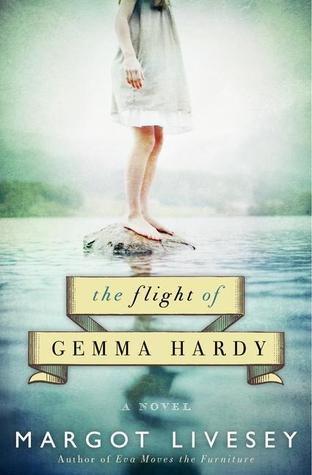
In Review: The Flight of Gemma Hardy by Margot Livesey

I’ve always had an interesting relationship with Charlotte Bronte’s novel Jane Eyre. I first got to know it via my grandmother who re-read it often in the final years of her life. It was easy to see how much she loved the book.

Three years after her death, I first read it for a high school class. I felt sure I would love it too …and felt terribly disappointed when I didn’t. I suspect I just wasn’t ready for the story yet. That my initial response felt flat may have also been because of my deep desire to love it for my grandmother’s sake.

Eventually I fell into the story the way I had hoped to the first time. It happened in a college class. Multiple readings and a number of movie adaptations later have left me with a definite fondness for Jane Eyre, which is what recently led me to pick up Margot Livesey’s The Flight of Gemma Hardy.

I confess I was intrigued at the idea of an “updated” Jane Eyre. Homages to Austen abound, but this is the first time I’ve read an attempt to update Bronte. (I assume other attempts are out there and I’m just behind the curve.) 

 Livesey decided to bring the story into the 20th century and set it in Scotland and Iceland, both fascinating choices. Gemma, this version’s Jane, is an orphan, born to a Scottish mother and Icelandic father. When her parents pass away in her early childhood, she is brought from Iceland to Scotland by her mother’s brother. She is warmly embraced by her beloved Uncle, who makes her a part of his family, but when he dies in an accident when Gemma is only ten, her Aunt and cousins begin to treat her like a distant acquaintance. Her older boy cousin bullies her and the girls closer to her age either tease her or ignore her. Her Aunt is truly cold. Her only allies are the family cook and a sad but likable school teacher who tries to encourage her in her studies.

Gemma is smart enough, even at ten, to realize that her next years will be miserable ones if she doesn’t try to find another home. She applies and is accepted as a “working girl” pupil at a boarding school called Claypoole. Claypoole gives Bronte’s original Lowood a run for its money in coldheartedness and neglect. It felt a little harder to believe that such a school could exist in the mid-20the century (given child labor laws and so forth) but then again, sin is sin in any age, and there will sadly always be people who take advantage of vulnerable populations such as poor children.

These early sections of the novel fare well as an update of Bronte’s classic. Gemma’s Dursley-ish relatives and her difficult years at Claypoole echo Jane’s early years and yet are invested with fresh details that make Gemma’s character come alive as Gemma, not just a pale echo of Jane. Her desire for friendship, fascination with bird-watching, and interest in her distant Icelandic past make the character real and sympathetic. Although any Bronte reader can guess the contours of what’s coming – the one true friend dying at school, Gemma leaving school to become a governess on a wealthy estate – it’s still interesting to see how those contours play out in a new setting and with a character who traverses them differently than Jane.

The novel fares less well once we arrive at Blackbird Hall, the update of Thornfield. The rich and sophisticated Hugh Sinclair is this novel’s re-imagined Mr. Rochester. Like Rochester, he gets relatively few scenes and we mostly come to know him through the main character’s eyes. Unlike Rochester, he never seems all that alluring or mysterious.

This may have to do with the fact that Livesey has stepped away from the gothic sensibilities in which Jane Eyre is drenched. That’s probably a smart and even necessary move, but it means that Sinclair’s past, though not without its secrets, feels a lot less murky. He’s more a genial middle-aged man who has made mistakes and would like a renewed shot at happiness with a younger woman whose innocent strength refreshes him than a grizzled, damaged old soul who has done some awful things and finds, in an unexpected soul mate, his one chance at redemption.

I kept waiting, truly curious, for the updated big “reveal” – knowing that Sinclair couldn’t possibly have a mad wife in the attic – the moment that would shock and dismay Gemma so much that she would be compelled to run off, alone and friendless, into the modern-day equivalent of the ruthless moors. The equivalent of those moors, the streets of a Scottish city where Gemma finds herself wandering without any cash (her purse having been stolen on a bus) turn out to be an effective setting for her to do some painful but necessary growing up. It’s in that city that she meets the re-imagined St. John and his sisters, with a scholarly postman named Archie standing in for St. John. I confess I liked Archie immensely and was frustrated by the plot point employed to get him offstage and move Gemma on to her search for birth relatives in Iceland.

But I wasn’t convinced that Mr. Sinclair’s revelations about his past were sufficiently shocking enough, or carried enough weight into the present, to compel Gemma to run off from his estate, and their imminent wedding, in the first place. Bronte gave us big plot points – outer events and moral dilemmas that cause Jane to run. I couldn’t shake the sense that this novel, by contrast, relies more on Gemma’s inner emotional promptings and psychological misgivings. Despite her attraction to Mr. Sinclair, something about the potential new life with him just doesn’t feel right to her. She intuits that she hasn’t seen enough of the world or learned enough about who she is, in and of herself, to make the decision to get married.

Funnily enough, it’s this subtle move that ends up feeling like the book’s biggest departure from its source material: to me, despite hardships and emotional privations, the faith-filled Jane Eyre always feels deeply sure of her own soul, just unsure of how best to live out her love in a very broken and imperfect situation. Marriage and caring for another flawed human being are doorways for Jane, doorways that never seem to threaten or diminish her sense of self, but only provide real ways to flourish. Gemma, though highly intelligent and sensitive, feels much more insecure about who she is, and – perhaps in the book’s nod to the more contemporary ethos – worries that marrying too quickly will somehow rob her of the chance to find out.

Though the ending didn’t quite work for me, I’m still glad that I read The Flight of Gemma Hardy. Livesey’s lovely prose and well-drawn characters drew and kept me in the story, and though I didn’t agree with all her story choices, I was intrigued by many of them. I appreciate any novel that makes me think about narrative choices this much. I also appreciate the strength of a re-imagined classic that refuses to cling so strongly to the original that its voice feels like a weak echo. That never happens here. Though Gemma and Jane might not understand each other entirely, I definitely have a sense that, if they could ever meet, they’d find plenty to talk about.

Thursday, April 17, 2014

Storyteller's Workshop: William Shakespeare's Star Wars


Lately I’ve been enjoying a word I don’t often use or ponder: pastiche.

Isn’t that a great word? Try it out a time or two and let it roll around your tongue. It looks like it might be pistachio flavored, but in reality it’s rather pasty. According to the Oxford Dictionary, it comes to us from French and Italian, based on the late Latin pasta, meaning (no, not spaghetti) 'paste'.

This makes sense, because a pastiche is essentially a pasting together of styles. It is (to quote the dictionary again) “an artistic work in a style that imitates that of another work, artist, or period” or “an artistic work consisting of a medley of pieces taken from various sources.” I like the notion of “a medley of pieces” – somehow when that combines with the notion of “paste,” I come up with a visual image of a mosaic.

The pastiche that has me thinking about all of this is William Shakespeare’s Star Wars: Verily, a New Hope. This delightful book by Ian Doescher is a 169 page iambic pentameter riff on the original 1977 Star Wars film. Think of it as the Bard of Avon with a light saber in his hand, a rumble between imperial forces and William Shakespeare and George Lucas (“Great, kid! Don’t get cocky!”), or a mosaic picture of Darth Vader made up of thousands of tiny words. Words that make up 3,076 lines, to be precise. The author counted them, and assures us in his afterword that this is about the average length of a Shakespearean play. 

When I stumbled onto this book on our library’s new book shelves, just the thought of it made me smile. Star Wars and Shakespeare seemed like a potentially happy marriage, and in Doescher’s hands it really becomes one.  His love of and familiarity with both worlds makes the dance a smooth delight, as though Luke, Leia, Han and our other beloved Star Wars characters have just been standing in the wings of the Globe theater, awaiting their cue.

It’s a wonderful read, from C-3PO’s opening line: “Now is the summer of our happiness/Made winter by this sudden, fierce attack!” to the ominous prequel-setting ending: “There let our heroes rest free from attack,/Till darkness rise and Empire striketh back.” I think what made me happiest, as I sped through it, was the delightful way the old/new form brought freshness to content I’ve known by heart for years.

The Shakespearean cadences lend extra nobility to the already noble Rebel cause. Luke’s turning to the Rebel cause, in the wake of his Aunt and Uncle’s deaths, feels truly poignant. Han’s self-preserving, scoundrel self is particularly wonderful in Shakespearean mode. When Han appears to take the money and run, in the scene prior to the Alliance’s final attack run on the death star, I love Luke’s bitter play on words “Then take thou care now, Han, thou Solo act,/For certain ‘tis the part thou best dost play” which leads into an introspective soliloquy from Han (after Luke exits). “Without the inner compass of my soul,/How can I vainly hope to pilot life?” he asks, and adds “A smuggler’s heart doth keep calm time inside,/No matter sways a pirate’s peaceful pulse./But something stirs in me I ne’er have felt:/Is this a rebel’s heart I feel within?”

Obi-Wan gets the smallest makeover, but I think that’s probably because Alec Guinness delivered all his lines with Shakespearean gravitas to begin with. Darth Vader seems darker and more tragic. R2, whose beeps fall into iambic rhythm, gets asides (in English!) that help us understand his feisty droid soul. Leia gets a “sing hey and lack-a-day” lament song for Alderaan. In short, this is a brilliant bit of pastiche.

Creative Prompts and Exercises

  • Time for you own pastiching. (And yes, the Oxford dictionary says it can be used as a verb!) Try choosing content you know well – a story or a scene from a story – but writing it in a completely different form than the original. Borrow a well-known form or voice to do it. Here are some possibilities:

Borrow the Bard’s favorite poetic cadence, iambic pentameter (an iamb is an unstressed/stressed syllable pattern; just put five together for pentameter) to write a speech from the perspective of a favorite character. This could be a re-write of an already existing speech or a quiet soliloquy spoken at a time when the character doesn’t originally speak in the story (but you have a feeling you know what’s going on in their heart and mind).

Borrow Dr. Seuss’ simple sing-song cadence and love of nonsensical words and re-write a favorite scene from a novel, short story, or fairy-tale.

Borrow a classical fairy-tale form (read Grimm, Perrault, Andersen stories for inspiration) and re-tell a non fairy-tale, perhaps a contemporary, modern story, in that mode.

Choose any writer whose style you find distinctive and enjoyable to emulate and give this exercise a whirl. Hemingway’s short, jabbing sentences; Tolkien’s meandering yet purposeful world-building prose; Bronte’s gothic or weather-drenched atmosphere making; Lewis’ kind-uncle story-telling narrator voice in Narnia – choose one of these or another writing voice you know and love well, and try telling a completely different story through it. Feel free to borrow liberally from your source materials – familiar words, phrases, story moments, plot devices. They won’t mind. (At one point, Doescher has Luke hold up a stormtrooper’s helmet and exclaim “Alas, poor stormtrooper, I knew ye not,/Yet have I ta’en both uniform and life/From thee…”)

Doescher paired Star Wars and Shakespeare because, despite their vast differences, he saw similarities in them (especially in the way Star Wars utilized “archetypal characters and relationships”). You may want to make a similar choice – maybe a modern character you love has always seemed ready to walk into the pages of a Dickens novel – or you may want to try unusual pairings that don’t seem to have anything in common at first glance. Who knows? You might discover connections between them or new nuances in character. At the very least, you’ll have fun!

Tuesday, April 15, 2014

Tax Day...and Mary Oliver's "Dog Songs"

The beautiful book find of yesterday: Mary Oliver's Dog Songs, just sitting there waiting for me on the new book shelves at our little library here in town. If it could have wagged its tail in friendly greeting, it would have.

I scooped it up happily and brought it home, but a very busy day (lots of work deadlines right now) meant that I didn't open it until late last night. It was past midnight, in fact, and I was bleary eyed from working but in need of winding down before sleep. I started at the beginning and smiled my way through several poems, but then flipped through at random, which is how I discovered "Percy Speaks While I Am Doing Taxes."

Knowing that in a few short hours I would be crawling out of the warm covers to do my local taxes before the deadline, I turned to the poem -- and laughed aloud. I love the picture Oliver paints of her patient dog waiting for her to finish this "essential" task so they can get on to the truly important business of taking a walk. I love that her own words feel like thoughts and the dog's speech gets the solidity of quotation marks.

Percy, I say, this has to be done. This is
essential. I'll be finished eventually.

"Keep me in your thoughts," he replies. "Just because
  I can't count to ten doesn't mean 
I don't remember yesterday, or anticipate today.
I'll give you ten more minutes," and he does. 
  Then shouts--who could resist--his
    favorite words: Let's go! 


Friday, April 11, 2014

Granola Bars. Really Good Ones.

Yes, granola bars. I don't often post recipes on my blog, but this one, originally posted at Smitten Kitchen (and which I've been meaning to try for a while) was a definite hit. For some reason, I was pretty sure that homemade granola bars would be hard to make and that I wouldn't make them well, and neither of those things turned out to be true.

These are in fact very yummy. I especially liked that I could throw together whatever I happened to have on hand to make the 2-3 cups of dry ingredients. One reason I wanted to make these now was that my sister recently sent us a little gift of dried fruit, and I thought it would be fun to use it to provide some variety in the bars. It worked beautifully. I cut up some of the dried apricots, pears, and even prunes (the sweet girl nixed the dates, as she doesn't like them much) and then threw in raisins we had on hand and also some dried cranberries and a few dried cherries. I added in some really good shredded coconut from Bob's Red Mill and we tossed in some good sesame seeds for good measure. Oh, and we had cashews on hand and I chopped those up and added them as well. Bob's Red Mill Oats were our base, and I pulsed some of them in the blender to make oat flour (which also worked great).

It suggests baking them for 20-30 minutes. I left them in closer to 30 minutes, not wanting to underbake, but I think 20 is probably a better idea. They may seem too soft at 20, but close to 30 (at least in my oven) made them a little too crunchy. Of course, even crunchy these are really, really good!

The sweet girl and I are already planning to try another batch with different combinations of things -- maybe peanut butter (which we didn't use this time around) and chocolate chips. Tonight's bars were only mildly sweet and the cranberries and sesame seeds gave them more of a tart/healthy feel than a decadent dessert one. Again, I like that this is a basic and very adaptable recipe.

Tuesday, April 08, 2014

Lenten Reading: Pondering St. Augustine

For part of my Lenten reading this year, I've been working my way through the devotional readings in Bread and Wine, published by Orbis Books. This is a richly diverse collection of readings from Christians of various traditions and across a number of years. It has a lot of my favorite writers in it (one of the reasons it caught my eye) but has also been introducing me to some writers I didn't know as well. It's also giving me lots of food for heart and mind from some of the classic writers of Christian devotion.

This was part of this morning's reading, from St. Augustine's Confessions:

"The Maker of man was made man, that the Ruler of the stars might suck at the breast; that the Bread might be hungered; the Fountain, thirst; the Light, sleep; the Way, be wearied by the journey; the Truth, be accused by false witnesses; the Judge of the living and dead, be judged by a mortal judge; the Chastener, be chastised with whips; the Vine, be crowned with thorns; the Foundation, be hung upon the tree; Strength, be made weak; Health, be wounded; life, die. To suffer these and suchlike things, undeserved things, that He might free the undeserving, for neither did He deserve any evil, who for our sakes endured so many evils, nor were we deserving of anything good, we who through Him received such good."

Amen and amen. I'm reminded afresh of how important the whole of Jesus' life is for us -- the incarnation, his earthly life, his passion, death and resurrection -- how the whole of that life catches us up and brings us into the eternal life of the Father, Son, and Holy Spirit.

It also reminds me of another meditation by a much more recent Christian poet and ponderer, Michael Card. From his song "The Cross of Glory":

From the pages of the prophets
He stepped out into the world
And walked the earth in lowly majesty
For He had been creator
A creature now was He
Come to bear love's sacred mystery
He the Truth was called a liar
The only lover hated so
He was many times a martyr before He died
Forsaken by the Father
Despised by all the world
He alone was born to be the crucified
Upon the cross of Glory
His death was life to me
A sacrifice of love's most sacred mystery
And death rejoiced to hold Him
But soon He would be free
For love must always have the victory
Though no rhyme could ever tell it
And no words could ever say
And no chord is foul enough to sing the pain
Still we feel the burden
And suffer with your song
You love us so and yet you bid us sing

For love must always have the victory


Wednesday, March 26, 2014

Happy Spring! Annual Crocus Poem and HB to Robert Frost

Last night I was walking onto the seminary campus around twilight. Some of the trees there are in full bud, looking as though they might burst into bloom any day in spite of the still very cold temperatures. I was marveling over the buds and also a lovely birds' nest tucked into one of the branches, when snowflakes started to drift down. Clearly winter hasn't quite gotten the memo about letting spring really start...

But start it has, and I'm grateful. Spring means several things (besides wished for warmer temperatures), including my precious mom's birthday -- she turned 82 last week -- and my parents' anniversary. This year it  was their 60th, an amazing milestone that had our whole family celebrating and feeling baskets full of gratitude for days.

Today is my own birthday, and despite the continued cold temperatures and my ongoing cough, congestion, and plain old tiredness, the gratitude continues.

The sweet girl and I spotted the first crocuses of the year more than two weeks ago, but I didn't get around to writing my annual crocus poem until last week, and then I never had a chance to post it. I thought I would celebrate today by keeping up this tiny tradition:


Seventeen crocuses bright in the cold,
Their petals so purple, their yellow hearts bold.
Though winter decided to have one more fling,
It couldn’t quite stop the onrush of spring.

~EMP, 3/19/14

If you want to see some of the crocus poems from earlier years, click on the "crocus" tag below the post.

And don't forget to read some Robert Frost poems in honor of his birthday today too. He's a tad bit older than I am, born in 1874. I think he's looking pretty good for 140! 


Monday, March 24, 2014

Storyteller's Workshop: The Princess Bride


Our Netflix disc arrived damaged a couple of weeks ago, leaving us with a Saturday evening planned movie night and no movie. Too tired to get creative, we turned to our tried and true stash of films and decided to watch The Princess Bride.

Like many people, we’ve watched this 1987 film directed by Rob Reiner so many times that we can quote much of it by heart. If you’re a fan…well, go ahead…take a moment here to relive some of your favorite lines with relish. “Have fun storming the castle!” is one of my staples, though there are many others that pop up in our conversations (sometimes in ways that make sense and sometimes just randomly…)

Although we’ve watched it many times, it had been a while since we’d seen it, and I found myself watching it with more freshness than usual. In particular, I found myself intrigued to realize just how low-budget this endearing and enduring film looks, and how much the lack of “wow effects” of any sort doesn’t hurt its grand storytelling one bit. William Goldman, who wrote the screenplay based on his own novel of the same name, does a terrific job of getting to and sticking with the heart of the story. Yes, it’s brilliantly casted and acted with incredible panache and humor, but if the characters and plot hadn’t been drawn so well, I don’t think it would have become such a beloved classic.

Here are a few takeaways from The Princess Bride for us as storytellers.

1)      A great framing device goes a long way.

Think about how different this film would be if it had just been a straightforward narrative. If we had started with Buttercup and her Farm Boy, we would have entered right away into a fairy-tale world. Instead we start in the “here and now” of 1987, in a small boy’s room when the boy is home from school sick. His grandfather arrives to read him a story, one his father used to read to him and one he also read to the boy’s father when he was little. We can tell this story is golden gem for the grandfather, but the boy at first is resistant. We enter the story via his youthful skepticism and enjoy the chuckles that come from his initial resistance to the romantic elements in the tale. (The grandfather has promised him adventure, so why is there all this kissing?)

The film doesn’t just use this storytelling device at the beginning and end. Periodically, throughout the tale, we’re interrupted by the boy’s questions or exclamations. The action essentially freezes (or sometimes jumps ahead…a very useful transition tool!) while the grandfather responds to the boy’s reactions. So we’re never allowed to forget for a moment that we’re traversing the realm of story. We traverse it with the storyteller and story listener, falling as deeply and magically into the story as they do. I think this is as close as a movie has ever come to replicating the magic of falling into a book.

2)      It can be important to know what your characters want.

This is one of the first rules of good storytelling, and one that teachers tell their writing students over and over. I can still hear variations of it in the voice of one of my literature professors in college! But we really see it in action here. Buttercup and Westley want nothing more than to be together (and believe that nothing can stop true love!) but there are plenty of obstacles, often caused by things that the antagonists want, like starting a war with Guilder.

My favorite instance of knowing just what a character wants, however, comes via Inigo Montoya. Inigo never lets us forget his quest: a six-fingered man killed his father when he was eleven, and he has spent his life training as a swordsman so that when he eventually catches up with this villain, he will be able to defeat him. After first declaring, of course: “Hello! My name is Inigo Montoya. You killed my father. Prepare to die.” With a set-up like that, we know we’re bound to see a six-fingered man before long, bound to get the scene where the two of them finally fight, and bound to hear Inigo utter that line he’s spent his life rehearsing. Our anticipation builds because of the set-up. And the pay-off, when we finally get it, is terrific.

3)      Sometimes it’s smart to play against type.

Sometimes a character seems utterly predictable because of what he or she looks like or appears to represent. On second glance, we learn that there is much more to the character than meets the eye – and that, in fact, a part of his or her personality seems to be directly opposite of our expectations. The supporting character Fezzik is a perfect example here. An enormous giant, he’s originally hired by Vizzini (actually working for Prince Humperdinck) to help kidnap the princess. He’s clearly valued by Vizzini for his giant size and brute strength, and we initially expect him to be thuggish.

It turns out that Fezzik is gentle and kind. He hates hurting anyone and doesn’t think it’s “sportsman-like” to take unfair advantage in a fight. He also has a love for rhyming games, a game we see Inigo, his good friend, encourage him in (one of the many reasons we come to love Inigo). All of these elements make Fezzik endearing, but especially so because they seem to play against our initial impression and the expectations of other characters.


Creative Prompts and Exercises

·        Take a story you know well, either one you’ve written or an old tale you could easily re-tell, and create a framing device for it. Is the story being shared with a child? Could the story be an important memory passed on from one generation to the next? Is someone telling the story at an important occasion (a wedding, a funeral, a reunion) a setting that will have more meaning for us at the end when we understand its significance more fully because of the story?

·        Create a story with at least three characters who know exactly what they want. Make one character on a quest of some sort. Make one character want something that will potentially block the first character from getting what he or she wants. Create another character whose goal is to help the first character achieve their goal (thinking through carefully why it’s so important for that character to help the first one).

·        Create a character profile for a “stock” character who looks predictable. This could be a hero, jock, beautiful princess, giant, bookish poet, or frail and elderly woman. The idea is to give the character certain traits that we expect that kind of person to have. Make them look predictable, and then have them do, say, or be a certain way that plays completely against that stock type.

·        Just for fun…if you’re a fan of The Princess Bride, try writing a “missing scene.” What was going through Westley’s head on the day the Dread Pirate Roberts first threatened to kill him? How did Humperdinck choose Buttercup to wed? What was life like for Inigo the day after he saw his father die? How did Vizzini meet up with Fezzik and Inigo? The possibilities are endless. Remember, it’s okay to play in someone else’s fictional universe, and it can give you good practice in writing dialogue and actions for characters whose quirks and motivations you already understand.

Sunday, March 23, 2014

Another New Feature: Storyteller's Workshop

Last week I launched a new feature here on the blog. Marmee's Library will be my semi-regular reviews of children's literature, tailored to be especially helpful for teachers and parents.

This coming week I'm launching another new feature. I'll be calling these posts Storyteller's Workshop. Each post will celebrate good storytelling, and will feature a discussion of a story (book, film, or otherwise). We'll look at some elements in the story that help make it come alive for readers or viewers. I love talking about what makes a story work well! In addition to reflections, each post will include creative prompts or exercises which I hope will be helpful for writers of all ages.

Stay tuned for the first Storyteller's Workshop post tomorrow! 

Wednesday, March 19, 2014

From Marmee's Library: Seesaw Girl by Linda Sue Park


In recent years, Linda Sue Park has become one of my favorite writers. I was going to say “writers for children,” because she does indeed write for children, but in point of fact, I think she has become one of my favorite writers period.

I first encountered her 2002 Newbery award winning A Single Shard. Set in 12th century Korea, it tells the story of Tree-ear, an orphan who longs to become a potter. As I wrote in my review of the book back in 2010: “This kind of work is story-telling at its finest, lean and gentle, filled with adventure but also with grace.” It’s about as pitch-perfect as a novel can be.

I’ve gone on to read a number of Park’s other novels and picture books, and my daughter, now eleven, has read a few I haven’t yet, but recently we discovered and read together Park’s very first novel, Seesaw Girl, published in 1999.

This is another gentle but moving tale told in Park’s clean, clear prose. Its 17 chapters cover only 90 pages, which include some beautiful black and white illustrations by Jean and Mou-Sien Tseng as well as an author’s note to further detail some of the Korean customs and settings. The book is set during the 17th century, about midway through the Choson period (which lasted from 1300-1880) in Korea. It tells the story of a young, aristocratic girl named Jade Blossom whose father is an advisor to the king.

As a reader, I was immediately pulled into the details of the place and time. Jade Blossom is a likable protagonist, the kind of young girl that many young girls will likely relate to. She plays pranks on her older brother and enjoys giggling with her young aunt and best friend Graceful Willow. She enjoys art, especially (at story’s beginning) the careful, decorative embroidery she is learning to do, but she’s not overly fond of chores, especially the complex processes involved in laundry day.

Beyond the universal likability of the character, however, there are the specific details of her circumstances. Jade Blossom lives the kind of protected life that most contemporary girls in the West will have a hard time fathoming. She is not allowed to leave the “Inner Court” of her family’s home. Since they are well-to-do, the home complex is fairly large, which means the Inner Court includes some outdoor spaces, such as the garden. So “she’s not like Rapunzel,” as my eleven year old put it.

Not quite locked in a tower, no, but still she must live within some very strict traditional constraints. These become more challenging for her as the narrative moves on, especially after Willow gets married. She essentially loses all opportunity to see Willow, since a new bride belongs almost exclusively to her husband’s family. The attempt to break tradition and go to Willow’s new home results in Jade Blossom’s first experience of the wider world outside her inner court. That experience inspires her to some complex feelings and questions.

As a writer, I appreciate, as always, the tidiness of Park’s prose. Tidy is the word I tend to think of when I read such tight, well-crafted writing.

I also appreciate the complexity of Jade Blossom’s characterization. Park must have walked a delicate line between the specific and the universal, wanting to be true to the time and place and those restraints that a character in Jade’s position would have really lived under, and yet wanting to craft a character who would resonate with readers now. I think she succeeds admirably, without falling into the mistake of making her too contemporary, but pulling on traits that somehow do feel believably universal.

It’s hard not to imagine that at least some of the girls of Jade’s status and time did not feel some level of curiosity, discontent, frustration, and anger. This must have been true even when they understood that this was just “how things were done,” and that they were done because their families wanted to cherish and protect their daughters. I like the way Park uses the distant mountains to symbolize Jade’s longings for a wider world. (It reminds me a little of the way I’m using the ocean in my work-in-progress, where my character lives in a small, land-locked country hemmed in by warring peoples on either side. In fact, Park’s delicate use of the mountains is helping me think through how I want to work the ocean more into my own story.)

With all that said, there is something about Seesaw Girl that feels like a first novel. It’s beautifully written on every level, and yet there is less lyricism in the prose and perhaps a little less development of the secondary characters than in Park’s later work, especially A Single Shard. I always think writers must feel frustrated when people compare an early book to a later masterpiece though, and I don’t mean anything denigrating by the comparison. It just somehow encourages me, as a writer, to know that Linda Sue Park had things to learn as a storyteller too.

As a teacher and parent, I am delighted by all the good takeaways from this novel. There is richness to be found here in history studies, literary studies, and character qualities.

History: this novel can enrich your young learner’s understanding of Korea in late-medieval-edging-into-early-modern times. So often, students don’t learn much about the Eastern world in the early history years. Even if you’re using a world history curriculum like Story of the World, information about Korea is pretty thin.

Seesaw Girl would fit right in with the information Susan Wise Bauer shares about Chinese influence in Korea in chapter 9 of SOTW Volume 2: The Middle Ages. In fact, it might be interesting to point out why Linda Sue Park intentionally chose the name Jade Blossom. As she says in this great interview: “At that time, Korea was a satellite state of China, and among the aristocracy or the nobility, the idea was to create a culture and a lifestyle within your home that was as Chinese as possible. I named the main character "Jade Blossom," which is a much more Chinese-sounding name than a Korean name because that's what wealthy families (like hers) at the time were doing.”

My daughter found it so unfair that Jade Blossom had not even been taught to read, when her brother Tiger Heart had so many academic opportunities. That point may be a great opening for discussion of illiteracy and educational opportunities for girls and women around the world, not to mention a cause for gratitude for the learning opportunities many of us take for granted.

The Peabody Essex Museum has provided this interesting social studies and art unit inspired by Seesaw Girl. 

Literature: The conflict in the novel is worth discussing. Jade Blossom is clearly the protagonist, but who or what is the antagonist? Although the rules of the household are strict and Jade Blossom is supposed to adhere to them, Park’s sensitive portrayal of Jade’s parents means that they are not precisely antagonists. (Get your students to think through how and in what ways Jade’s mother and father support and help her.)

It’s really cultural expectations that block Jade Blossom from what she most wants, and those are not easy to overcome. In fact, the narrative subtly raises the idea that perhaps sometimes there are things in life (like family honor and obedience) that may be as or more important than getting exactly what we want, even if what we long for is good. That leads us right into the next learning reservoir….

Character Qualities: There are really two virtues or qualities that stand out to me in this novel: contentment and creativity-within-limits. Jade wants many things that her limitations seem to block her from having: time with her Aunt Willow, freedom of movement, understanding of the wider world (both natural and cultural/political), and more complex artistic expression (she wants to learn how to paint, typically a male pursuit, and not just embroider, a woman’s more usual art).

By the end of the novel, she has not achieved all of these things, but she has taken small but creative steps, still working within the confines of her situation, toward more freedom. We see that in the way her father satisfies her curiosity about the political situation in the palace, in the way her brother Tiger encourages her painting skills, in her poignant conversation with her mother about a woman’s place in the household, and in her own ingenuity as she invents the seesaw game that allows her fleeting but real glimpses of the faraway mountains. Jade has not flouted her parents’ authority or eschewed cultural traditions to get her way, but she has found a respectful way forward that honors authority and tradition and yet enables her to grow and learn. It may not feel like enough for readers accustomed the bold and empowered characters of modern fiction, but it feels authentic to the story, and I think it has a lot to teach our contemporary, restless sensibilities.

Tuesday, March 18, 2014

First of Some New Features: Marmee's Library (Literature Reviews for Parents and Teachers)

It's been a busy month, and I've been writing "in the cracks and crevices." I've been missing my weekly review writing for Epinions.

One of the things I've realized, with the closing of that platform, is that review writing is in my blood. The other thing I'm realizing is that I can look at this season as a fresh new start and begin to craft some reviews, especially of children's literature, that are tailored more specifically for parents and teachers.

At some point I may collect these elsewhere. I've been considering launching a new blog, not to replace my journal space here entirely, but to provide a more specific resource space. But for now, I will be posting these reviews here under the heading of "Marmee's Library." If you find them helpful, I hope you will pass the word on to other readers, writers, teachers, parents, and homeschoolers!

I'll launch the first Marmee's Library review here tomorrow. Stay tuned!

Sunday, March 16, 2014

Monet Sunset, 1880 (An Original Poem)


One hundred and thirty-four years ago,
A man named Claude chose colors just so.
On canvas he captured his dream of the sky –
A misty cloud river, the sun’s golden eye.

He noticed each streak and shadow and hue
And wrung every drop from the beauty that’s blue,
He added some rose and a touch of fuzzed peach,
And showed slender limbs in their sinuous reach.

One hundred and thirty-four years have gone by,
But today I am blessed by his dream of the sky.

~EMP 3/10/14

Saturday, March 15, 2014

March Musings and Lenten Readings

March came in like a lion and thus far has not yet decided if it wants to be a lamb. We've had some lamb-like days, and then the cold comes roaring back. Illness (my own, the sweet girl's, D's) has kept us all a little off kilter this month. Spring teaching work has also kicked in, and I've had way too many plates spinning. Hence the resounding quiet here!

In the midst of everything, the season of Lent has begun. When I'm on the ball (heh...it has been known to happen) I usually do a pre-Lenten post about my reading for the season. Although that didn't happen this year, I thought I would still post a few thoughts about my reading.

As a family, we're still moving our slow way through the Psalms. We've been reading one Psalm a night for the past few months. Actually we started in the middle -- the sweet girl was intrigued to have us read all the way through Psalm 119, the longest one, and once we did that, we just kept going straight through to the end of the Psalter. Once we got there, we decided to start back at the beginning, and we're now at Psalm 93, almost all the way back around.

We've been a Psalm-ish family for years. We tend to read through them based on the daily readings, but we're not always consistent about it. We also have favorites we've revisited, meditated on, or mostly learned by heart through the years. Psalms 8, 23, 84, and 103 all come to quickly to mind, and there have been others.

For the past couple of years, I've been feeling especially close to the Psalms -- they've lodged in my heart and prayers in new ways. I appreciate their raw, deep honesty, and the way they cover so much of life, the parts that make sense and the parts that don't. They keep me God-oriented. So I am especially happy this Lent to be reading N.T. Wright's The Case for the Psalms. It is not just a book about the Psalms, but an invitation to live them and pray them. I am finding it good, good tonic for the soul.

Thursday, February 27, 2014

The End of an Era


Tuesday seemed like a fairly normal day for me. It was filled with ordinary blessings, busyness, and stress of various kinds, and not much writing time, as evidenced by the fact that when evening came, I hadn’t checked in at Epinions, one of the websites I write for regularly.

That’s not terribly unusual. I have days when I have to prioritize other things – teaching, ministry, or long-term writing projects – and don’t get to what I call my short-term writing projects at all or until late at night. What I didn’t know was that I had already written the last review I would ever write for Epinions. I got word in the evening that the site’s reviewing platform, fifteen years strong, was being shut down permanently.

To understand the shock of this for me, you have to realize a few things. I started writing for Epinions in May 2003, almost eleven years ago. When I started writing there, I was a recently turned 35 year old with a baby less than a year old. I have 1303 – yes, that’s one thousand three hundred and three – reviews and essays (mostly reviews) published at the site. That averages out to almost exactly 10 reviews a month for almost eleven years (yes, I did the math).

More importantly than the numbers, which show what a beloved habit writing for this site was, were the friendships I made there and the incredible amount I learned. What started as a mildly fun hobby – in my first several months on the site, I only wrote a handful of reviews and poked around on occasion, getting to know people and trying to figure out how things worked – picked up steam quickly. I had been looking for two things when I stumbled upon the site originally: a place where I could read good reviews of children’s books, and (once I realized I could contribute content) a place where I could keep my writing muscles exercised on a regular basis. That last felt hugely important to me when the sweet girl was a baby. My energy and time were both so limited (they still are, but in different ways) and I wanted to find a writing outlet where I could engage in real writing but have it be short-term writing, short pieces that had starts and finishes that felt manageable in the small spaces of a busy mom’s life. (I knew the novel and the longer non-fiction projects I wanted to work on would need to wait.)

The fact that the work was all self-directed and self-paced was a blessing. I could write and post as quickly or as slowly as I wanted and no one would mind. I could set my own deadlines and writing goals and try different ways of approaching reviews. The fact that I could write about what I felt most passionate about was beautiful. I liked that the posts were peer-reviewed, and quickly came to respect so many of the peers who were also writing and rating on the site. I liked knowing that my work had an actual audience. While the writing process brings me joy, a lot of it is lonely, and when you write never knowing if you what you write will see the light of day or communicate clearly to anyone, it can make the work feel that much harder. I knew I didn’t have a vast readership, but nonetheless, I had a readership.

I had taken journalism and feature article classes in college, neither of which, frankly, taught me a whole lot about how to write features. I remember struggling through a film review assignment for one of my classes (this was back in the 80s, pre-internet) and thinking how hard it was to craft a good review. I was right. A good film review is hard to write. I would have been astounded to know that one day I would write dozens (if not hundreds) of film reviews. Next to books, movies was my favorite category to write in at Eps; I was a top reviewer in the movies category for several years and was working to regain my momentum in that category when the site closed. Some of my early film reviews there weren’t very good – I labored long re-telling plot and often didn’t figure out what I wanted to say until I’d spent several hundred words – but my colleagues on the site, some of whom were dynamite writers, were encouraging with me anyway, and egged my enthusiasm on. So I wrote more of them, and I got better. When you labor at anything for a decade, you learn skills. I will always be grateful to my time at Epinions for helping me learn to craft strong leads and to hone my natural bent toward what I call “full-circle” pieces. One of my favorite methods for review writing is to bring the reader back around to an initial thought, impression, or assertion. I loved clarifying that skill over the past ten plus years.

There was also the richness of engaging in an incredibly diverse community of people who wrote about all kinds of things I’d likely have not read so much about otherwise. I learned about foreign films, musical instruments, gardening methods, adoptive families, classical music, best-selling thrillers, cozy mysteries, preschool picture books, cooking utensils, pet care, board games, business travel, and comic books. And that’s just off the top of my head!

And I made friends, at least one of whom, Erin, will be a life-long friend. We’ve emailed for years, blogged together, worked on stories together, gotten together in real life numerous times, prayed for each other, gotten to know each others' families and stories. In May, she’s getting married – to a man I’ve known for over a quarter century and had the privilege of introducing her to.

So forgive me if I wax a little nostalgic about the end of an era. In the grand scheme of the world, the sudden demise of a website looms small (and despite the struggles the site has had in recent years, the announcement was shockingly sudden as parent company eBay decided to retire the review platform effectively immediately). But this particular website has meant a lot to me. It’s been a long-term almost daily habit, a place to share passions and enthusiasms, a valued community of friends and colleagues, a place to keep my skills sharp, and if I shed a few tears when I heard the news, well…I think that’s pretty understandable. Although we weren’t given much chance to say proper farewells and do our grieving and celebrating onsite, a few hundred of us have found our way to a facebook page where those things are happening. I’m very glad they are. Epinions and the work and community it generated are worth celebrating.

Tuesday, February 25, 2014

Advice to Young Poets

I've been reading at Seeing the Blue Between: Advice and Inspiration for Young Poets compiled by Paul B. Janeczko. Lots of gems here, but I found myself especially loving two bits of advice to a young poet from J. Patrick Lewis.

"Book your eyes on a never-ending cruise: become a lifelong reader."
And "Nothing succeeds like failure. Revel in it. You may take a measure of pride if you can say, 'I failed three times today, and that was before lunch.'"