It's the birthday of author JK Rowling and her beloved fictional wizard Harry Potter! Jo Rowling is 49 (in real life) and Harry would be 34 today.
In honor of the day, I thought I would re-post a reflection from my archives. I'm cheating just a tiny bit -- or rather, double-dipping -- in that the post is just as much about Tolkien as it is about Harry Potter. Given that we're in the midst of The Two Towers right now as a family, however, I've had Tolkien very much on my mind, and happened to be revisiting this post today. It's an oldie but a goodie.
I hope Harry and Jo both gets lots of owl post today!
Thursday, July 31, 2014


Saturday, July 19, 2014
Eighty-Two
My precious father turned 82 today. I am so thankful for him in so many ways, and so thankful for all the ways the Lord has sustained his health in recent years. As he often says, he feels like he is living on gift time!
In honor of the day, I thought I would post a poem I wrote for him two years ago, when he turned 80. It still sings true.
In honor of the day, I thought I would post a poem I wrote for him two years ago, when he turned 80. It still sings true.
My father turns eighty today.
I know without asking
that he will celebrate
with an angel-food cake
topped with blue icing –
the same cake my mother
has faithfully made
for as many of his birthdays
as I can remember
and beyond.
Blue is my father’s color.
His eyes sparkle with it,
clear and bright, true blue
eyes my mother fell in love
with and still loves.
I picture him in blue,
the pale coarse fabric of
his long-sleeved work shirts,
the lighter, slicker blue of
dress shirts under suit coats.
One of those shirts is always
draped on the ironing board
of my memory, its white
buttons resting hard against
my cheek when we hug.
Blue is my father’s color –
The paint I see spilling
from the tubes next to his palette,
the hue of the musical notes
that flow from Gershwin’s Rhapsody,
the chipped sky blue of seats
at old Parker Field where we
watched minor league games
every endless summer, the slow
spread of July sky where I can
see him now, silhouetted against
the neighbor’s yard, hands cupped
to imitate the coo of mourning doves.
My father turns eighty today.
And I picture my mother
spilling drops of pure color
from a small bottle
into the white cream ocean of frosting,
swirling the spatters with her quick spoon
till they intermingle into a lovely
robin’s egg blue, festive and ready.
And it strikes me anew
that love is never just
the icing on the cake,
but that it decorates our days
in whorls and peaks
of ordinary brilliance.
~EMP
7/19/12
Monday, July 07, 2014
School Books Beginning to Arrive!
We spent the weekend resting and playing, including a day-trip to an historic French and Indian War site a couple of hours away. Though the end of the first week of July is really way too early to be thinking about school again, we have occasional happy blips when boxes of books arrive. I suppose that's one good thing about having to order things a bit at a time, as I'm paid for various writing and teaching projects...the books trickle in rather than crashing down on us like a waterfall!
Today made me smile because the grammar books arrived. (I know. I'm a geek.) The sweet girl struggled with grammar last year, not because it was too difficult, but because it was too easy. Her grammar skills are strong, and it turned out that Saxon and Hake 6 did a lot of review, too much for a student who didn't need it. Having invested in the books, and still wanting her to keep her hand in with some skill practice, I tried my best to steward the resources we had and utilize them for drill as needed. But I knew we needed something different this year, something that would be less rigorous and more supplemental. I also knew that I didn't want to purchase a full grammar curricula because those tend to be tied to writing programs which we don't need, since we already have a rigorous and fully-formed writing program (Writing With Skill) that really, really works for us.
What I ended up ordering was Exercises in English (grade 7) from Loyola Press. It's a supplemental workbook set to their larger curricula Voyages in English. S. wanted to take a look at it as soon as it came out of the box, and her assessment of it made me smile. She noted right away that it had a bit of color (it's printed as a one-color workbook, green, rather than just black and white) and that the quality of the paper felt and looked great. (Saxon uses a rather gritty and grayish newsprint, probably to cut costs, which I appreciate, but it's quite flimsy and tears easily. And it just doesn't feel substantial enough somehow.) She also noted that it had graphics, and that the lessons looked short enough that she really can use it as a daily drill. So my visual learner was really happy with the choice. All the things she noted were a big part of the reason I chose it! I've slowly learned over the years that the way information is presented really matters.
I noted the various sections were well-organized and seemed to cover grade-appropriate concepts, both some review and some newer concepts. I also liked the fact that many of the sections involving practice sentences cover good, appropriate topics or themes which I know she'll find interesting. Three topics that I happened to note at random involved outer space, Helen Keller, and the Chronicles of Narnia. It even concludes with a unit on sentence diagramming, something I find valuable and she finds enjoyable and not every curricula includes. All of this bodes well for less frustration and more actual grammar practice in the coming year. Yay.
Thursday, July 03, 2014
In Review: A Guide to the Birds of East Africa (A Novel)
I just finished reading a novel with the intriguing title of A Guide to the Birds of East Africa. Its title and size make it look like an actual field guide, but in fact it's a fictional story about a man living in Kenya who happens to love birds and bird-watching.
It turns out that Kenya, with over 1,000 species of birds, is a great place to be an ornithologist. Novelist Nicholas Drayson has a wonderful time describing many of the birds that protagonist Mr. Malik spots. He spots a lot of them because he's in a competition with an old school frenemy named Harry. Harry is a wealthy ex-pat who has recently come back to Nairobi for a visit. He decides he likes Rose Mbikwa, the lady who leads the weekly bird-walk at the local museum, and wants to ask her to the annual Hunt Club Ball.
When Mr. Malik overhears this, at his club, he almost despairs, because he is smitten with Rose and has been planning to ask her himself. Rather than put her in the quandary of having to decide between them, the two gents decide to have a bird-watching contest to decide who gets to ask her first/have the right of first refusal. (The other can only ask her if she's turned the winner down.)
The rules for the contest are very specific, as spelled out by three other gentlemen at the club. And it comes down to this: whoever has seen the most species by the end of the week wins.
The reader is set up to sympathize with widower Mr. Malik from the start. Harry, while not precisely a villain, seems light-weight in comparison with Mr. Malik, whom we get to know quite well as the week progresses. Harry is not above enlisting a lot of help and throwing around a lot of money to try to win the contest, but Mr. Malik, who happens to be having a not-very-easy-week (among other thigns, his car gets stolen) is also ambivalent about taking time away from some of the things he does regularly in his everyday life. We begin to realize how important his volunteer work is, both to his own soul and to his local community, and we feel torn with him as he tries to decide the best way to spend his days. The fact that he really seems to be in love with Rose, who is oblivious to the contest being held in her honor, also ups the stakes.
Drayson does a lovely job of painting the vibrant city of Nairobi and other areas of Kenya (since Harry hops some charter planes and heads to various parks). From the sewage area where Mr. Malik spots a lot of his birds to a local village where he finds surprising support on a difficult day, we feel like we get a real glimpse of this culturally diverse area. Most of all, we get multiple glimpses of beautiful birds, most of which I'd never heard of, all of which sound fascinating. Chapter headings include simple line drawings of some of the birds, but I found myself wishing I had a real field guide to East African birds while I read, just so I could see some of them in living color. Drayson does a good job, however, of painting their colors for us in words. It turned out to be a lovely summer-time read with an ending that didn't feel as predictable as you might expect.
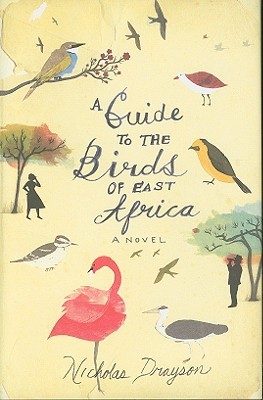 |
| (Book image from Goodreads) |
It turns out that Kenya, with over 1,000 species of birds, is a great place to be an ornithologist. Novelist Nicholas Drayson has a wonderful time describing many of the birds that protagonist Mr. Malik spots. He spots a lot of them because he's in a competition with an old school frenemy named Harry. Harry is a wealthy ex-pat who has recently come back to Nairobi for a visit. He decides he likes Rose Mbikwa, the lady who leads the weekly bird-walk at the local museum, and wants to ask her to the annual Hunt Club Ball.
When Mr. Malik overhears this, at his club, he almost despairs, because he is smitten with Rose and has been planning to ask her himself. Rather than put her in the quandary of having to decide between them, the two gents decide to have a bird-watching contest to decide who gets to ask her first/have the right of first refusal. (The other can only ask her if she's turned the winner down.)
The rules for the contest are very specific, as spelled out by three other gentlemen at the club. And it comes down to this: whoever has seen the most species by the end of the week wins.
The reader is set up to sympathize with widower Mr. Malik from the start. Harry, while not precisely a villain, seems light-weight in comparison with Mr. Malik, whom we get to know quite well as the week progresses. Harry is not above enlisting a lot of help and throwing around a lot of money to try to win the contest, but Mr. Malik, who happens to be having a not-very-easy-week (among other thigns, his car gets stolen) is also ambivalent about taking time away from some of the things he does regularly in his everyday life. We begin to realize how important his volunteer work is, both to his own soul and to his local community, and we feel torn with him as he tries to decide the best way to spend his days. The fact that he really seems to be in love with Rose, who is oblivious to the contest being held in her honor, also ups the stakes.
Drayson does a lovely job of painting the vibrant city of Nairobi and other areas of Kenya (since Harry hops some charter planes and heads to various parks). From the sewage area where Mr. Malik spots a lot of his birds to a local village where he finds surprising support on a difficult day, we feel like we get a real glimpse of this culturally diverse area. Most of all, we get multiple glimpses of beautiful birds, most of which I'd never heard of, all of which sound fascinating. Chapter headings include simple line drawings of some of the birds, but I found myself wishing I had a real field guide to East African birds while I read, just so I could see some of them in living color. Drayson does a good job, however, of painting their colors for us in words. It turned out to be a lovely summer-time read with an ending that didn't feel as predictable as you might expect.
Wednesday, July 02, 2014
The Gospel According to Frozen
Our family came late to the Frozen phenomenon. We didn't see the film until it came out on DVD, and though we all loved it, and the sweet girl has come to love it even more after several viewings, our singing of those darn catchy songs came six months after most people got stuck on them. We've laughed over several parody songs and videos (my favorite may be "Do You Wanna Go to Starbucks?") and enjoyed singing the actual songs around the house thanks to a library-borrowed copy of the soundtrack. Oh, and fallen firmly in love with Olaf, of course.
S. ended up watching it again the other day, and I sat down to enjoy it with her as I'd promised. It was the first time in a while that I'd watched the whole movie instead of just snatches, and I found myself impressed again by the lovely visuals, the smart storytelling, and that great narrative choice at the end that shows the power of sacrificial love and pays tribute to the wonderful bond of sisterhood. (Just in case you're one of a handful of people who has not yet succumbed to seeing the film, I'll try to keep that vague.)
A couple of other things really impressed me this time through, however, and I found myself thinking "that'll preach" at least twice. Once comes in the reprise of "For the First Time and Forever" when Anna is in the ice palace talking to Elsa, trying to convince her that together, they can fix the terrible winter that Elsa accidentally set loose when she lost her temper and gave into fear.
Anna's sweet earnestness is so palpable here: she is just so relieved that she finally gets why her sister has been hiding for so long, and is sure that the two of them, standing firmly together, can find a way to make things right. She also has a touching belief that her sister is capable of undoing the damage she's done -- she's sure that Elsa will not only want to do the right thing, but that she'll be able to find a way to undo it. It hasn't fully dawned on her that Elsa not only doesn't know the extent of the damage she's inadvertently inflicted, but has no clue how to reverse it...and is more terrified than ever of anyone, especially her beloved sister, getting close to her in case she accidentally hurts her again. It's a powerful musical reprise, with the two of them singing together but once again showing in their words how far apart they are. Anna sings her sweet assurance, while Elsa sings her despair, ending on the crushing clashing words "I CAN'T!"
It's those words that give me shivers every time; they come from such a deep place of fear, and accompany Elsa's unintentional unleashing, yet again, of crushing hurt. And yet there's freedom in the words too, when you think about it. In emotional and spiritual terms, this is where Elsa pretty much hits rock bottom -- she's completely at the end of herself, and there's nowhere to go here but up. Yes, things get crazier later on, mostly when she's threatened by the usurpers who see her struggles as their opportunity to cash in and make a power grab, but there's something almost more freeing in this "I can't" moment than in anything in the "Let it Go" song, when Elsa is re-learning the joy of the creative powers of her gifts, but reaching the firm conclusion that the only way to be free is to shut herself off from everyone else in case she loses control again.
The other bit I never noticed came ever earlier, when Elsa first accidentally hurts Anna when they're children. She is devastated that their joyful playtime turned frightening and that her attempts to save Anna from injury actually ended in hurting her. When her parents take Anna to the trolls for healing, the head troll makes the comment that he can help her because it's only her head that's received the freezing jolt, not her heart. Cold minds and thoughts, as it turns out, are not good, but they're somehow still on the surface, far easier to heal than frozen hearts. I love this insight: that it's the heart that matters the most. At the root, it a heart problem that needs help and healing we cannot provide for ourselves, and only true love (sacrificial, deep, real true love) can ever fix a damaged heart.
Yup. That'll preach.
Tuesday, July 01, 2014
The Love of Annotated Book Lists (and Blessing the Memory of Gladys Hunt)
This morning, the sweet girl was lingering at the breakfast table (oh, happy summer days!) perusing Gladys Hunt's Honey for a Child's Heart. It makes my own heart very happy to see that she has inherited her mother's love for reading annotated book lists. It's one of my favorite reading past-times, and a great way to discover more books I want to read!
My twelve year old daughter (yes indeed, I can say that now...the birthday weekend festivities are now behind us!) noted that the author Gladys Hunt had also written a book called Honey for a Teen's Heart, and asked if I could find a copy for her. I went looking in our library system, which seldom fails me, but today I could only turn up the earlier edition of that book, from 1992, with a slightly different title. The 2002 revised edition is for sale in various places, and I think I am going to swing a copy from Advanced Book Exchange and chalk it up to a school year purchase. I have always liked Hunt's lists...not only trustworthy book choices (and fun to read annotations) but usually accompanied by small but cogent essays on the importance of reading, why and how we read for best enrichment, ways to discern good qualities in literature, and so on.
Since the last edition of Honey for a Teen's Heart came out in 2002, the year my own almost-teen (gulp) was born, I went looking to see if perhaps there was a third edition in the works. Alas, I see that Mrs. Hunt, rest her soul, passed away in 2010 at the age of 83. Though saddened to hear that news, it was edifying to read her obituary and to discover that in addition to writing these great books for families, she and her husband had a long and fruitful ministry with InterVarsity Christian Fellowship for many years. I was also happy to see that her archived blog from Tumblr is still up, with many good posts about children's and young adult literature.
All of this is making me wonder where I can find good book lists (of the trustworthy and spiritually-rich variety) on young people's literature since 2002. I'm sure there are many blogs and other online resources, and perhaps some new collections too. As I begin to hunt that down, I will report back any finds here! I may also, of course, need to begin my own annotated list.
Wednesday, June 25, 2014
From Marmee's Library: Alice's Adventures in Wonderland by Lewis Carroll
Lewis Carroll loved wordplay so much that even his pen name
was playful. Born Charles Lutwidge Dodgson, he created his pseudonym by
dropping off his last name, coming up with Latin translations of his first and
middle names (“Carolus Lodovicus”), bringing those translations back into
English as Carroll Lewis, and reversing their order. If that sounds convoluted,
just wait until you read his books!
I first tried reading Alice’s Adventures in Wonderland as
a little girl, without any guidance from adults. Sometimes that’s a happy
thing. In this case, I could have used a little help. With no one to tell me it
was supposed to be nonsense, I just thought I somehow wasn’t “getting it” and reluctantly
closed the book and put it back on the shelf for many years. I think had my
early diet of nonsense been richer, I might have realized more quickly that
this story was supposed to be fantastical and funny. A college Victorian
literature class taught me to appreciate many of the enjoyable puns and plays
on words, but truly, this isn’t a book to encounter initially in a literature
class as much as a book that should be read-aloud, preferably with others, some
of them young, and enjoyed for its absurdity.
That’s what my family and I recently did, and it proved to
be a delightful exercise. After all these years, I finally feel that I “get” Alice, not because of any
sudden “a-ha!” moments, but because I just flat out enjoyed it along with my
husband and eleven year old daughter.
As a teacher and a
parent, I enjoyed being able to introduce my daughter to a classic book
that has become such an engrained part of literary and popular culture. The
lack of coherent story-line in Alice
hasn’t given it the narrative staying power of some classics, but its images
and turns of phrase are iconic. Given the fact that the story is an unfolding
dream sequence, it’s perhaps not surprising that the images stick with you as
they do. Even if you’ve never read the book, you’re likely to have some inkling
that it includes a fall down a rabbit hole, the grinning Cheshire cat, Alice
swimming in a pool of her own tears, the Queen of Hearts and all the playing
cards who attend her, and the Hatter (often referred to as the Mad Hatter) at
the tea-party.
Alice
was originally published in 1865; it’s been adapted, retold, and illustrated
countless times on stage, screen, and page. My best early associations with it
were a ballet adaptation I saw in grade school, and the 1951 Disney film.
Though John Tenniel’s original illustrations are themselves iconic, my daughter
loved the brightly colored, whimsical work of Alison Jay in the 2006 reprint we
picked up at the library. They were a big part of her enjoyment.
Alice
provides a great introduction to the concept of parody, though many of the
poems that Carroll parodies are unknown to modern audiences. That might decrease their humor to one level
but the humor is definitely still there, and in the places where the source
material is still familiar – such as when he turns “Twinkle Twinkle Little
Star” into “Twinkle Twinkle Little Bat” – the double pleasure in the nonsense
shines through.
As a reader and
writer, I appreciated the way Carroll keeps you off balance. I mean that in
the most charitable way. We don’t often think of 19th century
children’s literature as quickly paced, which makes Alice’s madcap adventures all the more
interesting. She moves from one adventure and fantastical encounter to the next
with nary a place to breathe, and it’s all the more confusing because her own
perspective (hence ours) keeps changing.
Our family had some interesting discussions about how old we
thought Alice
was supposed to be. In Through the
Looking Glass, she claims she’s seven and a half, which surprised us all –
though as my daughter pointed out, there’s no reason to assume it’s a sequel; it
could just as well be a prequel. I think we all thought, during our reading in Wonderland, that she was a few years
older, primarily because her experience of feeling either too small or too big
for everything, as she grows and shrinks, captures that “tween” sensibility so
perfectly.
The learning resources for such a treasured classic are
numerous. You might want to start at the Resources page for the Lewis Carroll Society of North America. There’s so much there, you might not need to look
anywhere else.
Saturday, June 21, 2014
Thankful Heart
There are times when I am very hard on myself as a parent. When you have a dear child who struggles, sometimes intensely, with anxiety of all sorts, it's very easy to second-guess yourself at every turn. My daughter struggles hard every day to come to terms with brokenness and uncertainty, and the older she gets, the more she becomes aware how much life is full of both. I have an internal dialogue that goes something like this "Am I pushing her too hard? Am I not pushing her enough? Is she ever going to reach a place of enough healing on some of these issues that she will be able to make it through this life, which is filled with uncertainty, with more joy and peace than anxiety?" I can have those kinds of thoughts even in the midst of a relatively good day or week, when I realize how far she's come, but they especially whack me on the hard days.
So sometimes I just need to sit back, take a deep, trusting, cleansing breath, and remember what a delightful person she is and how hard she is trying to engage life with courage and creativity.
I love it that my almost twelve year old is coming up with creative ways to spend her summer, even in the face of disappointment over changes to long-standing summer plans. I love that she
- is boldly taking a art class at a local art center, where she's never taken a class before
- has an eighteen book TBR stack in her room
- has begun reading Moby Dick just to see if she can
- is learning new embroidery stitches
- wants to begin daily drawing times again with me in July
- is looking forward to the celebration of her birthday
- is gardening with me again in the community gardens
- is excited about building a model bridge with her dad (they've been measuring things to make it to scale)
- will be taking workshops later this summer to keep her Irish Dance skills fresh
- is loving our family read-aloud of Lord of the Rings
- thinks it's cool that we're learning about the Lord's Prayer from a book by Kenneth Bailey
- is working on an entry for the county library picture book contest
Tuesday, June 17, 2014
Tolkien Summer
I've begun blogging about our family's summer reading of The Lord of the Rings. We began reading Fellowship of the Ring on Sunday night, and I've gotten a couple of posts up since! If you'd enjoy following along, you can find what I hope will be a daily (or at least regular) log here.
Monday, June 16, 2014
Stones That Bear a Witness
Last week, I posed a discussion starter question to my
church history students, one which has turned out to be a thought-provoking one
for me as well. I asked them to ponder the “visual books” of Gothic cathedrals
and how they represented the medieval synthesis that was so much a part of
Christendom, and then to think about modern structures or spaces and what they
might be communicating about our particular time and place.
The students did some good thinking, and their reflections
ranged far and wide over a number of modern spaces, from movie theaters to
shopping malls to church buildings to houses and skyscrapers. I was especially
intrigued with their thoughts on shopping malls, because I’ve been reading the
beginning of James K.A. Smith’s book Desiring the Kingdom, in which he
talks about “cultural liturgies.” He provides a fascinating several- page
description of a shopping mall, not chiefly as a functional place of commerce,
but as a space that shapes our desires and evokes a religious response in us (more
on this another time, I hope…I had the chance to hear him lecture the other
evening, and I’ve been chewing on it since).
In our discussion of church buildings, I found several of my
students confessing that they found many modern worship spaces sterile and
uninviting, built primarily to spare expense and to be able to maintain
multi-purpose functions. I agree with them, but I also confessed to some inner
wrestling on this very subject over the years.
On the one hand, I see the practical value of meeting in
spaces that are more functional and less “obvious” in their churchiness. From
my perspective, this is less about making people feel at home in the “familiar”
and more about reminding ourselves that the church is not primarily a building,
but a community of people. When we invest oodles of money and time into
maintaining a space, then we run the risk of investing less time and money in
the work and joy of being the church. We also run the risk of tying ourselves
so firmly to a beloved space (and space really can be beloved) that we forget
how to travel light. So church buildings, even beautiful ones, can sometimes
detract us from mission.
On the other hand, I see a real value in creating a space
that is beautiful. When our churches invite people into a sacred space that
looks different from the everyday, it can remind us all of the true beauty and
holiness of God and his kingdom. Such spaces, in their very beauty and
creativity, can glorify God who has made us people of creativity with a longing
to worship and a longing to know the ultimate beauties of his presence and his
realm. Such beauty can even help usher us into a deeper sense of his presence,
becoming an incarnational aid and reminding us that God speaks through ordinary
stuff, and that we are encultured people
called to sing his praise and manifest his goodness in a material world.
If you have doubts about that last line, think for a minute
about the church you knew first as a child. You may not remember a word that
got preached from the pulpit or a program that you attended. Chances are,
however, that you do have an impression of something physical that has stayed
with you through the years – a window, a
pew, a cross, a communion table, a candle. And no doubt you have a memory of
someone in that church who loved you, taught you, prayed for you, sang with
you. We remember love, and we remember physical places. And those physical
places often give us some of our first understanding of who God is and what he
is like, understandings that can stay with us for a lifetime.
I wonder if this is not something we see running through
Scripture, a sort of tension between a worshipping people of God who “travel
light” and stay on the move (the moveable, portable tabernacle) and a people of
God who plant themselves solidly in one place and build something tangible to
witness to his glory (the amazing temple). Clearly there is a place and time in
the vision of God for both. And I’m not sure it’s as easy as saying “well, once
the people entered the land, they could build” or “once the building was
destroyed, it was a signal to disperse and move again.” There are God’s words
to David about not needing a house built by human hands, even though he
realized how much David longed to build such a space. And yet there is the fact
that God did allow Solomon to build the space, and that he envisioned such a
space being a place of prayer for all peoples. The lack of permanency of such a
space – it gets built and destroyed, built and destroyed again – does say
something to us about the finiteness of any human cultural project, no matter
how grand and worthy and real. But clearly there was a time and place for the
people of God to stay put and be an inviting light, a call that I think
sometimes resonates with us more deeply in our modern times when so many people
are transient and so many home spaces are broken.
But then (there keeps being another “on the other hand”
moment…I’m starting to feel like Tevye) it strikes me with force that where we
see the most detailed instructions about building and beauty come in the
wilderness. It is there that we see God’s detailed instructions – right down to
music, colors, decorative scheme, measurements, clothing, and candlesticks –
about the beauty and majesty of the portable, moveable worship space the people
were to build and carry with them as they journeyed. Maybe there is something
for us to glean here? That we can build spaces that are both beautiful and
inviting and yet are spaces that we can “take with us” as we mission forth? That
we could even somehow build spaces that witness to the glories of a God who
travels with us in the desert and disperses us to the nations?
Tuesday, June 10, 2014
A Half Dollar and a Whole Lot of Love
The sweet girl and I were cleaning through a drawer earlier
today and found some coins I’d put away. I’ve always had a penchant for coin
collecting, and my daughter now has quite a collection, including most of the odds
and ends I’ve laid aside over the years. In among the Canadian coins and wheat
pennies today we found a couple of Kennedy half-dollars.
“Didn’t you once tell me a story about a fifty cent piece?”
she asked, and I smiled.
Imagine, if you will, a small and shy first grade girl who
was sent to school with lunch money. This little girl didn’t often buy her
lunch, preferring her mom’s homemade stuff in the lunchbox. But once in a
while, on a special occasion, she would take fifty cents to school to buy the
meal on the menu.
On this particular day, when it came time to get in line,
she looked in her little coin purse for the two quarters her daddy generally
gave her…and only saw one coin.
I don’t know if it hit her that the coin was bigger and
looked different. She certainly didn’t notice that it had the word fifty on it.
All that struck her was that she had only one coin when she thought she needed
two, and so…she didn’t buy lunch.
That shy first grader was me, of course. I only vaguely
recall the disappointment I felt over missing lunch. What I remember, with gratitude,
is my father’s loving response when I confessed that I hadn’t bought lunch
because he hadn’t given me enough money.
I don’t know if I can remember the exact words, but here’s
what has replayed in my mind and heart for years, which leads me to believe it
must be pretty close.
“Oh honey,” he said to me (at least in my memory it’s honey,
though it may have been some other term of endearment, like his favorite,
Lizzie-Ru) “didn’t you know that I’d always give you enough?” He showed me the
fifty cent piece in comparison with the quarter then, and explained.
Missing one lunch, even a special lunch, turned out to be no
big deal. But my daddy’s tenderhearted response has stayed with me for years.
I’m grateful that he helped me, even when I was so little, to trust him, and in
so doing, helped prepare me to trust the always faithful Father-heart of God.
“Didn’t you know that
I’d always give you enough?” could be words from God’s heart, because what our
heavenly Abba is the very best at doing is giving us himself.
Wednesday, June 04, 2014
The Lostness of Mad Men
We’ve recently been watching the second season of Mad Men. I find myself fascinated by the
writing and acting (and yes, costumes and sets) of this show, while not
necessarily always enjoying the stories. It’s probably a mark of how well written
and acted it is that I care about the characters as much as I do, even while
gritting my teeth over many of their actions and choices. For instance, I
honestly can’t understand how I remain sympathetic to Don Draper, whose
sometimes despicable choices make me wince (or make me want to smack him) and
yet for the most part, my main feeling for him is pity.
It’s the loneliness of the characters that keeps stabbing me
to the heart. The way they strive after success, prestige, youth, beauty, or
what have you is sometimes funny, sometimes awful, sometimes pitiable, but you
realize how many of them are just truly lonely. It’s particularly painful to
watch the scenes between the married couples, like Don and Betty and Pete and
Trudy, who seem to spin along like isolated tops, never orbiting close enough
to one another (even when they’re touching) to make a real connection.
A scene that took my breath in almost painful intensity the
other evening came in an episode when Betty had been yelling a lot at Bobby,
the youngest Draper child. It became clear midway through that her frustration
with Bobby was really misplaced frustration at her unfaithful and distant
husband. She kept snapping at Don, telling him he should discipline Bobby for
various minor infractions, and finally Don snapped and threw one of Bobby’s
toys against the wall (a toy the child had been playing with at the table) and
stormed out.
The boy, about five years old, came trailing
forlornly after his angry and frustrated father and lisped out a quiet “I’m
sorry.” Don’s angry face looked like it was about to melt. Quite frankly,
melting would be a good thing for Don, but he always seems to master whatever
emotion threatens to engulf him without surrendering to it. You could
practically see him take a deep, inward breath and pull himself together. “Sometimes dads get mad,” he said, kindly and calmly and inadequately, but at least it was
an admission of sorts that he’d lost his cool. “Did your dad get mad?” asked
Bobby curiously, and Don nodded and told him lots of times. “And your daddy’s
dead?” asked Bobby then, and Don responded, “He died a long time ago.” To which
the child replied, his face completely somber, “We need to find you a new
daddy.”
This heart wrenching scene actually ends in Don hugging his
son close, a tenderness we don’t often get to see. Talk about a beautifully
played and written one. That one childish remark cuts to
the heart of Don’s lostness, and the lostness of all the other characters too.
Everybody needs a loving father. We may especially feel it when we’ve lost our
earthly fathers or are estranged from them, but it’s just an underlying truth
for us all, regardless of what we've experienced with our human parents. Yet another reason to be deeply thankful for the loving Abba heart
of God.
Tuesday, June 03, 2014
Blessings at the Beginning of June
It's been a while since I've been in a regular writing rhythm here, but with the turn into June and our summer schedules, I hope to change that!
We had a beautiful...and I do mean BEAUTIFUL...(note the bold letters!) time celebrating the marriage of our dear friends Erin and Will this past weekend. We've known Will for the better part of three decades and love him dearly, and Erin has been a kindred spirit for close to a decade now too. Witnessing them pledge to live their lives and love together was a lovely moment of grace, and celebrating with them was just plain fun. I think the sweet girl told me it was her "best weekend ever."
Following on the heels of two days of preparation and celebration, we decided to meander our way home rather than to bolt...and it was a good decision. We took Sunday just to rest and enjoy the day and each other. We slept till we felt like getting up, breakfasted at the hotel, packed up, and headed to the peninsula for several hours of sun, wind, sand, and birdsong. We love Presque Isle.
We might have stayed a tad bit too long, but days like that are so rare and precious, it was hard to want to rush anywhere. Plus we all knew we'd sleep well whenever we finally did make it home to turn in. It was a bit hard to hit the ground running again yesterday, but we're moving into gentler summer schedules anyway, and that helped. We're still in transition regarding ministry this summer, which is making us all feel a little bit up in the air, but we're somehow even managing to weather uncertainty with more grace than usual. Thanks be to God! I think the beauty of the wedding has had lingering good effects.
And I can't get Mark Heard out of my head (he serenaded us much of the way up and back): "Love is not the only thing...but it's the best thing."
Friday, May 23, 2014
Maybe We Should Call Him Rocky...
We were glad to get to the end (or what we thought was the
end) of a long, tiring day yesterday. I was breathing a sigh when we’d finished
up family prayer and nighttime reading. It was a little after 10, and the sweet
girl was headed for bed. Her dad and I were headed for an episode of
“Elementary” (we’re hooked) and then also to bed.
And then came the noises.
I didn’t hear them at first. It was my husband who came out
of the kitchen with a puzzled look on his face. “I think there’s somebody in
the attic,” he said.
You have to understand that we live in an apartment in a
very old building. We’re housed over a warehouse which belongs to a local
business (the owner of which also owns our building). The attic space above us
is sometimes visited by workmen during the day, but there had never been anyone
walking around up there at 10 at night.
“Are you sure?” I asked. And then I heard the sweet girl,
from her room, shriek, “Mom? Dad? What was THAT?”
We hurried to her room. “What did it sound like?” we asked.
She looked seriously alarmed. Thud, thud, THUD, she told us.
I was starting to wonder why everybody in the house was
hearing noises but me when I heard something too. I went into the kitchen and
looked up at the ceiling, where the sound seemed loudest. Creaking (was it
footsteps? I couldn’t tell) and a kind of a bumping noise. And then some kind
of scraping noise that sounded like metal. Like someone might be dismantling
pipes. Or like Ron Weasley’s ghoul might’ve decided to move in.
We were all getting a little weirded out by then. I went
next door to see if our neighbor was home and to see what she made of it, but
she didn’t answer my knock. The sounds kept coming. I had misplaced our
landlord’s home number, so went hunting through the book. We didn’t want to
call the cops if there was something going on in the attic (“but what?” we kept
asking ourselves) that he had authorized.
I found a number that looked like it might be right and
tried it. It turned out to be my landlord’s somewhat elderly but very kind
mother, who happened to be up watching t.v. (“Oh, I’m always up late!” she
assured me cheerily, and then promised to call her sleeping son and wake him up
and get him to call me pronto.) When the phone rang a couple of minutes later,
I apologized for having him wakened, but then explained there were a lot of
really strange noises in the attic. “I’m afraid there might be a person up
there,” I said.
“Oh no, I don’t think so,” he assured me. “The trap must’ve
sprung. I’m pretty sure it’s a raccoon in a cage.”
Um…what?
It turned out, as I discovered, somewhat to my merriment
(it’s amazing how relieved you can be to find out it’s only a raccoon, when
you’ve been having visions of pipe- dismantling ghouls) that they had recently
figured out that a raccoon was somehow getting into the building’s attic. A
friend of our landlord’s, who is at trapper, figured this out from paw prints
on a blanket they left up there. He also set a cage to catch the creature,
complete with the enticement of red licorice. Apparently, the first time around,
the raccoon managed to abscond with the licorice and not get caught. Not last
night.
“It must’ve worked and the door closed on him. He’ll be OK
until morning, and then my trapper friend will get him out and set him free.”
(And presumably they will seal up whatever they can so no large wild animals
can roam into the attic looking for the licorice bar.)
“All right,” I said, as there came a loud THWUMP from the
ceiling, followed by a shake and a thud and a kind of rattle. “Just to let you
know, he’s pretty loud up there. I don’t think he’s very happy.”
He did settle down eventually, our friend Rocky (we figured
we may as well name him, since we were sharing a building with him for the
night). We all had a good fit of giggles over the entire thing, not a bad thing
following the stresses of the day. My landlord called back to check on us a few
minutes later and to apologize again.
I hoped for Rocky’s sake that there was a bit of the
licorice left so he could have a midnight snack. D. had to get up early for a
breakfast meeting and heard him again. Apparently Rocky decided to get up with
the sun. I’m pretty sure by now he’s out in the wild again, no doubt a bit
grumpy about his night’s adventure. Perhaps he’ll post about it on his blog
too.
Wednesday, May 21, 2014
Encouragement...It's For Every Day
Today I had the opportunity to read (over the shoulder, as
it were) two very kind messages. One was an email my sister wrote to my parents
to let them know about the passing of a dear family friend they hadn’t seen in
many years but still prayed for regularly. The other was a tribute that a
friend’s mother wrote to her on Facebook, congratulating her on the achievement
of my friend’s younger son graduating from high school this week – and marking the
culmination of 25 years of committed and creative homeschooling by my friend.
Something about both of these beautifully written messages
lodged in my heart. Both were sincere and heartfelt and wonderfully kind, a
quality that makes my heart sing whenever I see it. But the quality that most
stood out to me in both was encouragement.
Encouragement is one of those gifts that I think we get a
little lazy about in the church (and in the world at large, but I’ve been
pondering on this from the perspective of Christian community). We tend to
compartmentalize it by saying “well, so and so has the gift of encouragement,”
as though that lets the rest of us off the hook when it comes to offering encouraging words. But the Scriptures make it clear this should be a part of
our daily, ordinary practice as Christians. We are to “encourage one another
and build each other up” (1 Thessalonians 5:11) and “encourage each other every
day” (Hebrews 3:13).
I’ve been trying to get better about this in my own life,
offering kind and affirming words to others when I’m prompted to. It sounds
easy, but so often I either fall into critical mode (especially with my
daughter or other people close to me) or I choose not to speak because I think
I’m not the person that someone needs to hear from, or that they probably don’t
need encouragement since they seem to have it all together. But it’s not
necessarily my place to judge how much someone needs encouragement. It’s my
place, as a follower of Jesus, to just give it, sincerely and from the heart,
when he prompts my heart to do so.
Encourage. To give someone courage. To inspire them with hope
and confidence. I know how much I need encouragement every day. So I’m finding
new ways to try to say what I often think. “You’re really good at that.” “It
meant so much to me that you took the time to….” “I hope you realize what a
difference it makes when….” “I’ve heard such good things about…” And with my
eleven year old, sometimes words like, “I know how hard that is for you, and I
wanted you to know I noticed how you kept at it.” Or even just “you’re really
growing and learning!”
Sometimes it feels like the world tries to take our courage. Even when we feel thin on courage ourselves, we can still spread seeds of encouragement wherever we go.
Saturday, May 17, 2014
Poetry: The Art of Subtraction
I woke up two hours earlier than I usually do on Saturday and couldn't get back to sleep. It took me a couple of groggy minutes to realize it was because the early morning stillness was calling me to the page. After I had a brief quiet/devotional time, I got pen and paper (creeping around so I wouldn't wake anyone else up) and then snuggled down under a blanket to write.
I thought it was my novel calling out, and I did end up working on the beginning of chapter eight (you don't know how happy it makes me to be able to say "chapter eight" after about two decades of never getting past chapter three in a longer piece of fiction). I even worked for a bit on some notes for a possible script adaptation, one D. and I were talking about late last night before we fell asleep ~ ideas had apparently smuggled themselves into my sleeping hours. But much to my surprise, it was poetry that ended up being the most fruitful part of the writing morning. I wrote the draft of a poem yesterday -- first time in quite a while I'd dipped into poetry -- and this morning wrote three more!
I'm chuckling over the delight in quantifying the poetry writing experience.Unlike fiction writers, who love saying things like "I managed 800 new words today!" or even "I wrote 20,000 words this month!" poets seldom quantify. You rarely hear someone say "I wrote seven poems today!" or "wow, 246 new lines this month!" Maybe it's because anyone who has written a good deal of poetry knows that lines are going to be rearranged a dozen times and words and images pared down. While it's true that bigger isn't necessarily better when it comes to fiction either, I think it's possible for a good novelist to start with 20,000 words and still end up with that many when all is said and done, even while tightening and revising considerably. Stories have a way of expanding, filling up space, talking longer than we think they will. Poems, on the other hand, have the habit of getting quieter and smaller and tighter the longer we work at them, almost like a flower that's already bloomed re-closing into a bud and then opening again in a smaller, brighter, more perfect version of its earlier self.
My poem drafts are filled with cross-outs and parentheses, places where I realize I am being excessive with images or adjectives, lines where I question whether or not I really need to explain what I've just presented. Usually I discover that the image can speak for itself, or that if it can't, I need to work harder at helping it to. When I compose poems via the keyboard, a different kind of experience entirely, then the pages are filled with multiple copies of the same poem (thank goodness for copy/paste) with lines subtracted, rearranged, reformed. I still prefer writing first drafts by hand and revising via keyboard, but sometimes poems come unexpectedly and I do whatever feels right or handy in the moment.
The thing that still mystifies me most about poetry writing is where the ideas come from. It's such a lovely gift in that you never know what will spark the writing. The four poems I've worked on in the past two days each had a completely different seed kernel. The first came to me initially as a memory and a sound, the second was inspired by my reflection on a devotional reading this morning, the third mysteriously brought together two things I'd been thinking about but hadn't consciously put together (both things read about and contemplated during school time with my daughter), and the fourth was just a playful bit of response to a book I know and love well (the one I was working with for a possible script adaptation). Of the four, I think the one that's potentially the most powerful is the one where the two ideas came together in a surprising way. One way I can tell that it's working is that I've already gone back to it twice to cut and polish.
Friday, May 09, 2014
Reading Roundup, Early May
Having enjoyed Alice in Wonderland, our night-time
family read has us nearly to the end of Through the Looking Glass. I’m not
sure how this can be true, but I think it’s my first time through the whole
book. So much of it is familiar though – this is really where so much of the
great Alice stuff
happens! Jabberwocky! The Red and White Queens!
The talking flowers! The Walrus and the Carpenter! The White Knight and Six
Impossible Things Before Breakfast! It’s unevenly paced for a read-aloud, but
we’re having too much fun to mind.
In the mornings, we’re almost done with The Door in the Wall,
Marguerite de Angeli’s beautiful medieval novel about a lame boy named Robin.
It won the Newbery award in 1950. This is actually a re-read, but the sweet girl was so young the first time we
read it together, she doesn’t remember it. I really do love de Angeli’s
beautiful prose.
As for me, I am still on a P.D. James tear. I’m reading her
books more or less in order, and have finally made it into the 1980s with the
Dalgleish novels. I’m bogging down a bit this week with A Taste for Death (“what
a terrible title!” my eleven year old scolded me, though I did point out that
it was a quote from a poem) but I’ve got a feeling that I’m about to turn a
corner and pick up the pace soon.
I’m also perusing a lovely medieval costume book that’s
helping me think through clothing and fabrics for my work-in-progress. Yes, I’m
at work on the novel again.
Tuesday, April 29, 2014
Phantom Tollbooth Tech Week, Alice in Wonderland...and Lots of Other Nonsense!
So it's tech week for our household, that time each spring when my dear husband goes into "round the clock" mode as he shepherds a couple of dozen 4th-8th graders through the final week leading up to their play performance! This year it's The Phantom Tollbooth, and while we've missed...sort of...having Smaug the Dragon in our dining room (last year's play was The Hobbit) we've enjoyed helping to paint cardboard signs to mark Milo's journey to Dictionopolis and Digitopolis. D. built the tollbooth last weekend (it has to be something that can be assembled on stage) and we're all rooting for a great performance for the kids this coming weekend. And on Sunday we'll cap everything off with a celebration of D's birthday!
We've loved The Phantom Tollbooth for years, but having D. direct the play sent us back to the book. We've enjoyed the annotated version, though it was our old paperback copy we recently read from together. Re-reading Milo's journeys in odd and faraway lands got us thinking of other classic bits of literary nonsense. And it suddenly occurred to us that the sweet girl had never met Alice in Wonderland.
 She'd encountered some of the poems from Wonderland and Through the Looking Glass (she memorized "How Doth the Little Crocodile" a few years ago, and we've enjoyed Jabberwocky more than once) but she'd never made the entire journey through Wonderland. We picked up a beautiful reading copy at the library, with illustrations by Allison Jay, and have been enjoying the humor and word play. The sweet girl has been inspired by Jay's artwork and has done some of her own terrific Alice sketches. One of my favorites is her version of Alice falling down the rabbit hole, which she is kindly letting me share here!
In all honesty, I've never been a huge fan of Alice, though I came to a greater appreciation of it in a college Victorian Lit. class. This time through has definitely been my favorite read, partly because we're enjoying it as a family and partly because it's eye-opening to read it on the heels of Tollbooth and to think about the similarities and differences. While there's no doubt that Juster must have had Alice in the back of his mind somewhere when he created Milo, I truly love that for Milo, the real "wonderland" turns out not to be the lands he visits in the fantasy section of the story, but his own everyday world. Alice falls into Wonderland and returns to the "dull reality" of the real world; Milo learns lessons in the land of wisdom and returns home to find true wonder, to discover that "everything looked new -- and worth trying."
We've loved The Phantom Tollbooth for years, but having D. direct the play sent us back to the book. We've enjoyed the annotated version, though it was our old paperback copy we recently read from together. Re-reading Milo's journeys in odd and faraway lands got us thinking of other classic bits of literary nonsense. And it suddenly occurred to us that the sweet girl had never met Alice in Wonderland.
She'd encountered some of the poems from Wonderland and Through the Looking Glass (she memorized "How Doth the Little Crocodile" a few years ago, and we've enjoyed Jabberwocky more than once) but she'd never made the entire journey through Wonderland. We picked up a beautiful reading copy at the library, with illustrations by Allison Jay, and have been enjoying the humor and word play. The sweet girl has been inspired by Jay's artwork and has done some of her own terrific Alice sketches. One of my favorites is her version of Alice falling down the rabbit hole, which she is kindly letting me share here! In all honesty, I've never been a huge fan of Alice, though I came to a greater appreciation of it in a college Victorian Lit. class. This time through has definitely been my favorite read, partly because we're enjoying it as a family and partly because it's eye-opening to read it on the heels of Tollbooth and to think about the similarities and differences. While there's no doubt that Juster must have had Alice in the back of his mind somewhere when he created Milo, I truly love that for Milo, the real "wonderland" turns out not to be the lands he visits in the fantasy section of the story, but his own everyday world. Alice falls into Wonderland and returns to the "dull reality" of the real world; Milo learns lessons in the land of wisdom and returns home to find true wonder, to discover that "everything looked new -- and worth trying."
Monday, April 28, 2014
From Marmee's Library: The Midwife's Apprentice by Karen Cushman

My daughter loves Newbery award winning books. She has
expressed an ambition to one day read all of the Newbery medal books from 1922
to the present! This means I frequently find myself lurking in the library
corner that houses the Newbery winners. It’s not exactly a hardship. It’s also
how I’ve discovered some new gems for our read-aloud times, including the 1996
Newbery winner The Midwife’s Apprentice by Karen Cushman.
Now almost twelve, my daughter is tearing through books on
her own, but we still have two read-aloud times: bedtime and mid-to-late
morning. The latter is a school-time read and I generally try to keep it tied
to something she is studying in history, science, or art. Sometimes we read
biographies, but good, solid historical fiction is a big part of our morning
read-aloud diet, and The Midwife’s Apprentice definitely
fits that bill.
Set in an English village in the early 14th
century, The Midwife’s Apprentice tells the story of a homeless girl
taken in by a local midwife. She is given room and board and begins to help with
the midwife’s practice, though it takes her a long while to learn the skills
and even longer for her to realize that she’s learned them.
As a reader, I appreciated
the way I got to grow in awareness along with the girl. You’ll notice I’ve not
shared her name, and that’s because it takes a while for her to grow into one.
At the story’s beginning, she literally doesn’t know who she is, and thinks of
herself as “Brat” because that’s what she’s mostly been called. “You, girl,” is how the midwife first
addresses her when she finds her sleeping for warmth in a dung heap. Having
found her in such a place, the midwife, a very sharp woman (who happens to be
named Jane Sharp) begins to call her Beetle, as in dung beetle. It’s not much
of a step up from Brat. Part of the goodness of the story is watching Beetle
begin to identify herself with a new name, Alyce, and then begin to realize
that she’s not only worth a real name, but can continue to live and work in
ways that help her to live up to a good name.
As a writer, I
appreciate that Cushman doesn’t make it too easy on Alyce. Sometimes my
temptation is to create characters that I’d like to hang around with in real life.
My temptation here would have been to provide Alyce with a compassionate,
loving mentor who took her in, became the older sister or mother she’d never
had, and purposefully passed on her skills. Cushman, wisely, gives her Jane
Sharp instead, “a woman neither old nor
young but in between. Neither fat nor thin but in between. An important-looking
woman, with a sharp nose and a sharp glance and a wimple starched into sharp
pleats.” She clearly enjoyed writing that line, as she uses it again,
exactly, a handful of pages later, as if to emphasize that Alyce’s first
impression of the woman was solid.
Jane is not a terribly happy woman, nor a particularly kind
one. She views Alyce as cheap labor and sets her to fetch and carry, though
some of the fetching turns out to be for herbs, which gives Alyce some of her
first understanding of a midwife’s tasks. Still, almost everything Alyce
learns, she learns the hard way, the long way around. She watches everything
the midwife does, sometimes sneaking up to the window of a cottage where a
woman is about to give birth (Jane doesn’t usually let her stay inside to
help). This means she picks up on both the skills Jane possesses and her many
superstitious habits. There were plenty of those surrounding child birth in the
Middle Ages, some involving religious relics and others just secular eccentric
practices. Cushman packs in interesting details about these and about daily
life in a medieval English village, where few people could read and hardly
anyone ever bathed.
As a teacher and
parent, I appreciated the details that went into building up a
picture of every day life in the Middles Ages. There’s a surprising
realism to this story, from the dung heap where Alyce first sleeps to the
soiled straw on which many of the village women give birth to the rough ways
the villagers treat one another. Alyce is bullied by both Jane and a number of
the village boys. Young readers will, I think, come away with an authentic
sense of life in those days, not a sanitized or over-glamorous one. It worked
well to read this book in conjunction with medieval history studies around the
13th-14th centuries. Because it touches on issues like
midwifery, medicinal remedies, food, and cleanliness (or lack thereof), you can
easily tie it into studies of every day life or important historical issues
like famine and plague.
Teachers and parents should be aware that there are a few
gritty details during birth scenes, though nothing overly technical.
Likewise, there’s a scene where Alyce follows Jane to figure out what secret
she’s keeping, only to discover her “hugging and kissing” the baker, who is
married with thirteen children. This scene is played for its humor – Alyce is
so startled she falls out of a tree! – and Jane and the baker’s infidelity doesn’t
come into the story again. Likewise, there’s a scene where a young couple in
the village is caught “cuddling” in the
haymow, and the boy has to gather up his “breeches” before he flees. Again this
is played primarily for humor, as a series of pranks that Alyce plays on the
gullible villagers who are too prone to look for and blame the devil for every
bit of bad behavior that anyone is engaged in. Parts of that chapter might go a
little over the heads of readers on the younger end of 9-12.
Despite the fact that this is a Newbery winning novel, I’ve
not been wildly impressed by my admittedly cursory look at some of the literary
guides and study helps available for free online. A good round-up of what’s
available, in both paid and free resources, can be found here.
My favorite character quality take-away from
this novel is how Alyce grows into an awareness of the importance of perseverance.
Although she faces many practical obstacles, the chief conflict is inside her. She
learns many things: how to work hard, how to be kind to others, how to read
(yes, in a neat twist in the final third of the book, she really does)! She
also learns skills that enable her to deliver a baby in an emergency, also near
the end of the story. This comes after her failure to help another woman
deliver a baby and her running away from the village to a work in a nearby inn.
Alyce’s greatest learning is that failure doesn’t have to be the end of something.
She can learn from it and try again. Surprisingly, she learns this best from
the difficult and not-so-encouraging Jane, who lets her know in no uncertain
terms that she needs an apprentice who won’t give up when things get hard.
Waiting to see if Alyce can find the inner strength to step into that role
drives the novel’s satisfying conclusion.
Wednesday, April 23, 2014
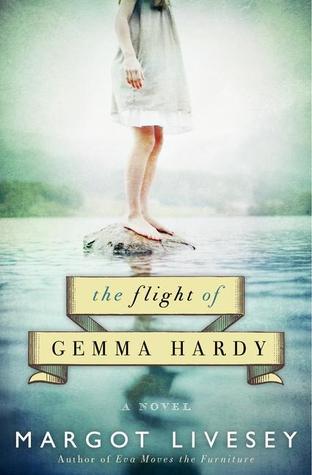
In Review: The Flight of Gemma Hardy by Margot Livesey
I’ve always had an interesting relationship with Charlotte
Bronte’s novel Jane Eyre. I first got
to know it via my grandmother who re-read it often in the final years of her
life. It was easy to see how much she loved the book.
Three years after her death, I first read it for a high
school class. I felt sure I would love it too …and felt terribly disappointed
when I didn’t. I suspect I just wasn’t ready for the story yet. That my initial
response felt flat may have also been because of my deep desire to love it for
my grandmother’s sake.
Eventually I fell into the story the way I had hoped to the
first time. It happened in a college class. Multiple readings and a number of
movie adaptations later have left me with a definite fondness for Jane Eyre, which is what recently led me
to pick up Margot Livesey’s The Flight of Gemma Hardy.
I confess I was intrigued at the idea of an “updated” Jane Eyre. Homages to Austen abound, but
this is the first time I’ve read an attempt to update Bronte. (I assume other
attempts are out there and I’m just behind the curve.)
Livesey decided to bring the story into the 20th
century and set it in Scotland
and Iceland,
both fascinating choices. Gemma, this version’s Jane, is an orphan, born to a
Scottish mother and Icelandic father. When her parents pass away in her early
childhood, she is brought from Iceland
to Scotland
by her mother’s brother. She is warmly embraced by her beloved Uncle, who makes
her a part of his family, but when he dies in an accident when Gemma is only ten,
her Aunt and cousins begin to treat her like a distant acquaintance. Her older
boy cousin bullies her and the girls closer to her age either tease her or
ignore her. Her Aunt is truly cold. Her only allies are the family cook and a
sad but likable school teacher who tries to encourage her in her studies.
Gemma is smart enough, even at ten, to realize that her next
years will be miserable ones if she doesn’t try to find another home. She
applies and is accepted as a “working girl” pupil at a boarding school called
Claypoole. Claypoole gives Bronte’s original Lowood a run for its money in
coldheartedness and neglect. It felt a little harder to believe that such a
school could exist in the mid-20the century (given child labor laws and so
forth) but then again, sin is sin in any age, and there will sadly always be
people who take advantage of vulnerable populations such as poor children.
These early sections of the novel fare well as an update of
Bronte’s classic. Gemma’s Dursley-ish relatives and her difficult years at
Claypoole echo Jane’s early years and yet are invested with fresh details that
make Gemma’s character come alive as Gemma, not just a pale echo of Jane. Her
desire for friendship, fascination with bird-watching, and interest in her
distant Icelandic past make the character real and sympathetic. Although any
Bronte reader can guess the contours of what’s coming – the one true friend
dying at school, Gemma leaving school to become a governess on a wealthy estate
– it’s still interesting to see how those contours play out in a new setting
and with a character who traverses them differently than Jane.
The novel fares less well once we arrive at Blackbird Hall,
the update of Thornfield. The rich and sophisticated Hugh Sinclair is this
novel’s re-imagined Mr. Rochester. Like Rochester,
he gets relatively few scenes and we mostly come to know him through the main
character’s eyes. Unlike Rochester,
he never seems all that alluring or mysterious.
This may have to do with the fact that Livesey has stepped
away from the gothic sensibilities in which Jane Eyre is drenched. That’s
probably a smart and even necessary move, but it means that Sinclair’s past,
though not without its secrets, feels a lot less murky. He’s more a genial
middle-aged man who has made mistakes and would like a renewed shot at
happiness with a younger woman whose innocent strength refreshes him than a
grizzled, damaged old soul who has done some awful things and finds, in an
unexpected soul mate, his one chance at redemption.
I kept waiting, truly curious, for the updated big “reveal”
– knowing that Sinclair couldn’t possibly have a mad wife in the attic – the
moment that would shock and dismay Gemma so much that she would be compelled to
run off, alone and friendless, into the modern-day equivalent of the ruthless
moors. The equivalent of those moors, the streets of a Scottish city where
Gemma finds herself wandering without any cash (her purse having been stolen on
a bus) turn out to be an effective setting for her to do some painful but
necessary growing up. It’s in that city that she meets the re-imagined St. John and his sisters, with a scholarly postman named
Archie standing in for St. John.
I confess I liked Archie immensely and was frustrated by the plot point
employed to get him offstage and move Gemma on to her search for birth
relatives in Iceland.
But I wasn’t convinced that Mr. Sinclair’s revelations about
his past were sufficiently shocking enough, or carried enough weight into the
present, to compel Gemma to run off from his estate, and their imminent
wedding, in the first place. Bronte gave us big plot points – outer events and
moral dilemmas that cause Jane to run. I couldn’t shake the sense that this
novel, by contrast, relies more on Gemma’s inner emotional promptings and
psychological misgivings. Despite her attraction to Mr. Sinclair, something
about the potential new life with him just doesn’t feel right to her. She intuits that she hasn’t seen enough of the
world or learned enough about who she is, in and of herself, to make the
decision to get married.
Funnily enough, it’s this subtle move that ends up feeling
like the book’s biggest departure from its source material: to me, despite
hardships and emotional privations, the faith-filled Jane Eyre always feels deeply
sure of her own soul, just unsure of how best to live out her love in a very
broken and imperfect situation. Marriage and caring for another flawed human
being are doorways for Jane, doorways that never seem to threaten or diminish
her sense of self, but only provide real ways to flourish. Gemma, though highly
intelligent and sensitive, feels much more insecure about who she is, and – perhaps
in the book’s nod to the more contemporary ethos – worries that marrying too
quickly will somehow rob her of the chance to find out.
Though the ending didn’t quite work for me, I’m still glad
that I read The Flight of Gemma Hardy. Livesey’s lovely prose and
well-drawn characters drew and kept me in the story, and though I didn’t agree
with all her story choices, I was intrigued by many of them. I appreciate any novel
that makes me think about narrative choices this much. I also appreciate the
strength of a re-imagined classic that refuses to cling so strongly to the
original that its voice feels like a weak echo. That never happens here. Though
Gemma and Jane might not understand each other entirely, I definitely have a
sense that, if they could ever meet, they’d find plenty to talk about.
Subscribe to:
Posts (Atom)