The 2006 book awards were posted yesterday on http://www.christianitytoday.com . I always find good reading material on this list. It's usually posted around mid-year, and honors books in the previous publishing year. In their own words, they're looking for "titles that bring understanding to people, events, and ideas that shape evangelical life, thought, and mission." 37 publishers nominated 240 books, and 22 were chosen in several categories overall -- each category usually has one winner and then one or more "awards of merit."
Although I've only read one of the winners -- Alan Jacobs' The Narnian was aptly chosen as the winner in the history/biography category -- I was happy to see several of my favorite writers and thinkers turn up, including N.T. Wright, Eugene Peterson, Ron Sider, Debra Rienstra, Lauren Winner, and James Calvin Schaap.
I'm perhaps most intrigued by the title that won in the "Christianity and Culture" category, but then my husband's a youth pastor, which may explain (at least partly) my deep interest in the subject matter: Soul Searching: The Religious and Spiritual Lives of American Teenagers (Christian Smith, Melinda Lundquist Denton, Oxford). The winner in the fiction category was also a new name to me, Nicole Mazzarella, whose novel This Heavy Silence was published by Paraclete Press. I find that intriguing because I think it's Paraclete that's been running the fiction contest in conjunction with Calvin College's Festival of Faith and Writing. I wonder if this novel got its start in that competition, or if good writers are just being attracted to Paraclete because of that connection?
And speaking of that wonderful festival held every two years in Michigan, I've never been able to attend, but have found so many good writers through its speaker lineup. In fact, that's how I found Schaap, an excellent short story writer. He's a novelist too, but I have really only read his shorter work. I actually have a slightly deeper connection with him as well, because six years ago, the Calvin Worship Institute ran a short fiction contest around the time of the Festival, and my short story "The Man in the Center" took second place. James Calvin Schaap was the judge and made some very kind and encouraging comments about my piece. His book Startling Joy: Seven Magical Stories of Christmas (Revell) took the award of merit in the fiction category, and is now on my wishlist for holiday reading a few months from now.
I'd be remiss if I didn't mention that Rowan Williams, archbishop of Cantebury and thereby the pastoral head of the Anglican Communion of which I'm a part, also has a book on this list which I'd like to read: Why Study the Past? The Quest for the Historical Church (Eerdmans). Could be interesting reading in light of current dilemmas in the communion. Also might be good for me to read this summer as I prepare to teach another church history course for the seminary in the fall.
Debra Rienstra, author of one of my favorite books on motherhood, has picked up an award of merit in the apologetics/evangelism category for So Much More: An Invitation to Christian Spirituality (Jossey-Bass). Yes indeed, that wishlist is growing.
Oddly enough, I wasn't too excited by the descriptions of either of the books that won in the theology category -- odd because, of course, I did my grad. studies in theology. Perhaps the blurbs sounded too dry and academic, and perhaps it's just where I'm at in this particular season of my life.
Why don't they award the best children's books? They should!
At any rate, check out the list...definitely some writers worth reading, both old and new.
Saturday, May 27, 2006


Friday, May 26, 2006
"Some Pig!"
We've been reading Charlotte's Web during family reading time. We started reading longer (older) books with the Booper as part of family reading when she was about two. Too much busyness with D's and my jobs and schedules, plus Boop's own sudden squirmy attention span during longer books this past winter, meant that we dropped the practice for awhile. I'm happy that we're reinstituting it now, with summer coming on. Thus far, we've mostly been reading on preschool mornings in the car on the way to school (partly to divert her attention from the stress she's been feeling about school) but soon we'll need to come up with a new time when we can all read together.
Anyway, she's really liking this lovely book by E.B. White -- a favorite from my own childhood. And I'm so glad! Earlier this afternoon, she was trundling around the house with her little painted wooden pig magnet (from a set of animal magnets Aunt Martha gave her last year) and delighted me by calling him Wilbur. She fed Wilbur a snack and even gave him a quick bath in the sink when she was supposed to be washing her hands. She likes to say "the pig's ears turned pink in the sun" which is an echo of a line we read the other day. And she's excitedly looking forward to the end of the book, when they go to a fair...I told her that was coming, knowing she'd be excited since we went to a fair just last weekend (where Booper got her first -- and second! -- pony ride!)
If you've never read Lauren Winner's lovely tribute to the genius of Charlotte's Web, you can check it out here at http://www.christianitytoday.com/bc/2005/005/12.28.html It not only includes fascinating biographical information about E.B. White and the many drafts he went through before coming up with that wonderful opening line "Where's Papa going with that ax?" but some very thoughtful stuff on the importance of community in writing, loving and living.
On my own, I've also been reading some James Herriot stories again -- for the first time in many years. I picked up a beautiful hardback copy of his Animal Stories several months ago at a used book sale. It looked like it had never been read, and his stories are so worth reading. Just opening the covers and moving back into the rural world of the beloved Yorkshire vet gave me a deep feeling of satisfaction, returning to a place I'd always enjoyed visiting but hadn't been to in a long time. Some of my most pleasurable reading moments as an adolescent were spent in Herriot's company; he writes beautiful prose out of years of keen observations of people and animals. If you know a child who loves animals but is ready to move on from Charlotte's Web (although of course CW is a book the child will go back to again and again!) then Herriot just might be an author to recommend.
Anyway, she's really liking this lovely book by E.B. White -- a favorite from my own childhood. And I'm so glad! Earlier this afternoon, she was trundling around the house with her little painted wooden pig magnet (from a set of animal magnets Aunt Martha gave her last year) and delighted me by calling him Wilbur. She fed Wilbur a snack and even gave him a quick bath in the sink when she was supposed to be washing her hands. She likes to say "the pig's ears turned pink in the sun" which is an echo of a line we read the other day. And she's excitedly looking forward to the end of the book, when they go to a fair...I told her that was coming, knowing she'd be excited since we went to a fair just last weekend (where Booper got her first -- and second! -- pony ride!)
If you've never read Lauren Winner's lovely tribute to the genius of Charlotte's Web, you can check it out here at http://www.christianitytoday.com/bc/2005/005/12.28.html It not only includes fascinating biographical information about E.B. White and the many drafts he went through before coming up with that wonderful opening line "Where's Papa going with that ax?" but some very thoughtful stuff on the importance of community in writing, loving and living.
On my own, I've also been reading some James Herriot stories again -- for the first time in many years. I picked up a beautiful hardback copy of his Animal Stories several months ago at a used book sale. It looked like it had never been read, and his stories are so worth reading. Just opening the covers and moving back into the rural world of the beloved Yorkshire vet gave me a deep feeling of satisfaction, returning to a place I'd always enjoyed visiting but hadn't been to in a long time. Some of my most pleasurable reading moments as an adolescent were spent in Herriot's company; he writes beautiful prose out of years of keen observations of people and animals. If you know a child who loves animals but is ready to move on from Charlotte's Web (although of course CW is a book the child will go back to again and again!) then Herriot just might be an author to recommend.
Monday, May 22, 2006
Dandelion and Rain Puddle

It's been raining and raining lately...seems like most of the past month! Today was a beautifully clear, blue-sky day, but I thought I'd go on and post one of our rainy day pictures from a few weeks ago.
My sweet girl has a fascination with puddles, as you can see. She loves to jump in them (much to her Mommy's secret delight and her Daddy's chagrin). She also loves dandelions!
Lately we've been reading a lot of stories about rain. Some of our favorites include Splish! Splash! A Book About Rain (where we learned all about the water cycle), Amy Loves the Rain, and Rabbits and Raindrops.
"...Like Putting on Clothes in the Morning"
Life's been very busy -- too busy, probably. Between work, parenting and writing (the three biggies in my life right now) I hardly ever seem to have a spare moment. This week I need very much to do some housecleaning and organizing, respond to a young friend who has asked for feedback on a short story he wrote, and also work on pulling together my fall syllabus for the online class I'll be teaching again for the seminary. I've also got plenty of other things on my plate, both big and small.
I need to remember to keep first things first, or to "major in the majors" as I heard someone say the other day.
It helps to keep reading words that put me back in that place, the position of listening for God's voice, the openness to receive and to be shaped.
A few days ago I read this, from Charlie Peacock's book New Way to Be Human (Shaw Books, 2004):
"...praying is like putting on clothes in the morning. It covers my nakedness and answers the Edenic question, "Where are you....?" My prayers announce my location and my status -- "Here I am, God!" -- dissolving any pretence that I am anything other than a small and needy man. This is the kind of effect Jesus has on people. It's all a part of his plan. He moves us from being the kind of people who use his creation to hide from him to being the kind of people who eagerly seek an authetic God-human conversation."
Or perhaps it would be even better to say that he moves us/changes us into the kinds of people who eagerly seek to respond to God's invitation to talk with him. We don't have to fear the "where are you?" question if our answer is "Here I am...I need you and love you! Come find me, God, and help me rest in your presence."
I need to remember to keep first things first, or to "major in the majors" as I heard someone say the other day.
It helps to keep reading words that put me back in that place, the position of listening for God's voice, the openness to receive and to be shaped.
A few days ago I read this, from Charlie Peacock's book New Way to Be Human (Shaw Books, 2004):
"...praying is like putting on clothes in the morning. It covers my nakedness and answers the Edenic question, "Where are you....?" My prayers announce my location and my status -- "Here I am, God!" -- dissolving any pretence that I am anything other than a small and needy man. This is the kind of effect Jesus has on people. It's all a part of his plan. He moves us from being the kind of people who use his creation to hide from him to being the kind of people who eagerly seek an authetic God-human conversation."
Or perhaps it would be even better to say that he moves us/changes us into the kinds of people who eagerly seek to respond to God's invitation to talk with him. We don't have to fear the "where are you?" question if our answer is "Here I am...I need you and love you! Come find me, God, and help me rest in your presence."
Thursday, May 18, 2006
The All-Consuming Nature of Consuming
I've been reading some of the essays in Rodney Clapp's Border Crossings. Clapp works at Brazos Press; the subtitle of this collection (published byBrazos in 2000) is "Christian Trespasses on Popular Culture and Public Affairs." Lots of interesting things here, but one of the most interesting is the essay I'm working through at the moment, entitled "The Theology of Consumption and the Consumption of Theology."
Early in the essay, Clapp shares a fascinating and troubling anecdote. The story was told to him by a Christian historian who had written a dissertation on consumerism. The historian told him about an experience he'd had with some college age folks at a Christian camp. The gathering included people from a number of different countries, and during the ice-breaker time, the groups were divided up according to their nationalities and asked to discuss and agree on a song that they could perform for the rest of the gathering -- a song that all felt represented their culture. According to this man, most of the groups had relatively little trouble agreeing on a song -- within a few minutes, they'd chosen and rehearsed it -- and nearly all of them chose what he termed "indigenous folk songs."
Except, of course, for the group from the United States. They couldn't agree. They discussed for an hour, rejecting various suggestions of rock and country songs. And then, as Clapp reports: "At last they settled -- on Coca-Cola's 'I'd Like To Teach The World To Sing.' The jingle ringing in his ears, Lendol {the historian} realized that commercial culture was what finally and ultimately bound these Americans -- these American Christians -- together."
I've been thinking about why this troubles me so much. There are several layers to my response, and I won't try to unpack all of them here. But at least a couple of things feel worth noting.
One is that we no longer seem to have a shared story in our culture. No real news there -- the enlightenment souned a death knell for an emphasis on "meta-narrative" in the West. But what I think I mean is that our national culture is so divided and subdivided that there doesn't even really seem to be one overarching cultural narrative anymore, if there ever was. You might be able to have people from a certain region or state come to some agreement about a song that expressed regional cultural attitudes and values, but trying to get a large group of US Americans to agree on something that represents our country to others sounds nigh unto impossible. Maybe that's not so unsettling -- maybe it's all part and parcel of our stubborn, rugged individualism (ugh) but what DOES seem troubling is when you move from the nationalist level to the community of faith level. What does it mean when American Christians (and I repeat Clapp's emphasis) find their deepest connections not in the overarching Christian Story, or not even in cultural songs that allude to some deeply cherished communal values, but in an advetising jingle that was designed in the first place to get us to buy something we didn't need that wasn't even good for us!?
Maybe it's because the narratives we all know are the small narratives told through t.v., movies, and advertising...they're the ones we hear over and over again, the ones we hold in common with lots of other people. Think about how many advertising jingles and t.v. theme songs you can sing. My own head is stuffed full of them, especially from childhood and adolescence. I have clear memories of sitting in a dorm lounge in college and singing through these kinds of things with friends. Thankfully, I also have memories of at least one "hymn-sing" in college, but that was an exceptionally unusual evening, even on the campus of the small Christian college I attended my freshman year (where the hymn-sing occurred). As for "indigenous folk songs" -- which ones did we all know? Maybe a few peans to primarily civil religion like "America the Beautiful" or "My Country Tis' of Thee" or possibly a few folk songs we'd all learned in school such as "This Land Was Made for You and Me."
If you and I were in a room full of other Christians from the U.S. today, what songs would we likely come up with to suggest who we are and what we value? What stories, themes, ideas shape us? Are we more shaped by what we buy, own and use than by the truly greatest Story ever told and known?
I need to think more about the dangers of consumerism, especially, as Clapp says, "consumerism...as an ethos, a character-cultivating way of life that seduces and insinuates and acclimates. This, too often, is consumption that militates against all sorts of Christian virtues, such as patience and contentedness and self-denial, but almost always with a velvet glove rather than an iron fist. It speaks in tones sweet and sexy rather than dictatorial, and it conquers by promises rather than by threats."
Early in the essay, Clapp shares a fascinating and troubling anecdote. The story was told to him by a Christian historian who had written a dissertation on consumerism. The historian told him about an experience he'd had with some college age folks at a Christian camp. The gathering included people from a number of different countries, and during the ice-breaker time, the groups were divided up according to their nationalities and asked to discuss and agree on a song that they could perform for the rest of the gathering -- a song that all felt represented their culture. According to this man, most of the groups had relatively little trouble agreeing on a song -- within a few minutes, they'd chosen and rehearsed it -- and nearly all of them chose what he termed "indigenous folk songs."
Except, of course, for the group from the United States. They couldn't agree. They discussed for an hour, rejecting various suggestions of rock and country songs. And then, as Clapp reports: "At last they settled -- on Coca-Cola's 'I'd Like To Teach The World To Sing.' The jingle ringing in his ears, Lendol {the historian} realized that commercial culture was what finally and ultimately bound these Americans -- these American Christians -- together."
I've been thinking about why this troubles me so much. There are several layers to my response, and I won't try to unpack all of them here. But at least a couple of things feel worth noting.
One is that we no longer seem to have a shared story in our culture. No real news there -- the enlightenment souned a death knell for an emphasis on "meta-narrative" in the West. But what I think I mean is that our national culture is so divided and subdivided that there doesn't even really seem to be one overarching cultural narrative anymore, if there ever was. You might be able to have people from a certain region or state come to some agreement about a song that expressed regional cultural attitudes and values, but trying to get a large group of US Americans to agree on something that represents our country to others sounds nigh unto impossible. Maybe that's not so unsettling -- maybe it's all part and parcel of our stubborn, rugged individualism (ugh) but what DOES seem troubling is when you move from the nationalist level to the community of faith level. What does it mean when American Christians (and I repeat Clapp's emphasis) find their deepest connections not in the overarching Christian Story, or not even in cultural songs that allude to some deeply cherished communal values, but in an advetising jingle that was designed in the first place to get us to buy something we didn't need that wasn't even good for us!?
Maybe it's because the narratives we all know are the small narratives told through t.v., movies, and advertising...they're the ones we hear over and over again, the ones we hold in common with lots of other people. Think about how many advertising jingles and t.v. theme songs you can sing. My own head is stuffed full of them, especially from childhood and adolescence. I have clear memories of sitting in a dorm lounge in college and singing through these kinds of things with friends. Thankfully, I also have memories of at least one "hymn-sing" in college, but that was an exceptionally unusual evening, even on the campus of the small Christian college I attended my freshman year (where the hymn-sing occurred). As for "indigenous folk songs" -- which ones did we all know? Maybe a few peans to primarily civil religion like "America the Beautiful" or "My Country Tis' of Thee" or possibly a few folk songs we'd all learned in school such as "This Land Was Made for You and Me."
If you and I were in a room full of other Christians from the U.S. today, what songs would we likely come up with to suggest who we are and what we value? What stories, themes, ideas shape us? Are we more shaped by what we buy, own and use than by the truly greatest Story ever told and known?
I need to think more about the dangers of consumerism, especially, as Clapp says, "consumerism...as an ethos, a character-cultivating way of life that seduces and insinuates and acclimates. This, too often, is consumption that militates against all sorts of Christian virtues, such as patience and contentedness and self-denial, but almost always with a velvet glove rather than an iron fist. It speaks in tones sweet and sexy rather than dictatorial, and it conquers by promises rather than by threats."
Monday, May 15, 2006
Another Bird
I frequently quote (sometimes out loud, sometimes inwardly) the wonderful stanza from Emily Dickinson that begins: "Hope is the thing with feathers/that perches in the soul..." I've always loved that little poem.
Just recently found yet another bird stanza that speaks (or sings?!) volumes to my heart. Here is it, from Victor Hugo:
Be like the bird
Who, pausing in her flight
On limb too slight,
Feels it give way beneath her
Yet sings,
Knowing she hath wings.
That's the kind of singing I think I understand best right now.
Just recently found yet another bird stanza that speaks (or sings?!) volumes to my heart. Here is it, from Victor Hugo:
Be like the bird
Who, pausing in her flight
On limb too slight,
Feels it give way beneath her
Yet sings,
Knowing she hath wings.
That's the kind of singing I think I understand best right now.
Tuesday, May 09, 2006
"What Keeps Us From Praying?"
I've been reading Richard Foster for the first time in a long while, doing some re-reading of chapters in his excellent book Prayer: Finding the Heart's True Home and also reading (for the first time) his small devotional book Seeking the Kingdom. Foster's long been a favorite of mine, but that doesn't mean his books make me comfortable. In fact, they often push me to reflect on my life in ways that reveal a lot of uncomfortable truths and areas that need the loving work of the Holy Spirit to change and heal.
I actually haven't been able to get past the very first devotional in Seeking the Kingdom, because there's so much to chew on in just those few pages. I'm still working on it, and letting it work on me. He asks the seemingly simple question: "What Keeps Us From Praying?" and suggests that it's not the outwardly obvious answer -- not enough time, too busy -- that's the most important answer. He points out that we don't let lack of time or busyness stop us from doing other necessary and important things, like eating or sleeping or making love (and let's be honest, most of us don't let lack of time and too much to do stop us from doing less essential things like watching t.v. or blogging, for instance!).
So: what keeps us from praying? Is there a lack of confidence that God is listening? A lack of trust or hope? A feeling that we're not "doing it right" or need to become better people with purer motives before we can approach God?
This has been a rich but sometimes painful question for me to grapple with, because I've been realizing that I have some real fears lurking right now -- about the call we're trying to discern, and our shaky life situation -- and that I sometimes act as though God is someone other than I know him to be, as though I'm afraid he is a hard taskmaster, one who's just out to ask me to be or do something that I don't want to be. I know better than this, from my own life with God in Christ and from the witness of the Scriptures. So why would I assume that God would only call me to something hard, or painful, or (and here's a big one) why would I assume that if God did call me to something difficult that he would not lovingly prepare and equip me to answer the call? Yes, he does sometimes call us to things we could never imagine for ourselves, and he sometimes calls us to give up even good things, but I know he is trustworthy and GOOD. I also know that he understands my human frailty and exhaustion, and that he knows my real deep needs for rest and refreshment. When the hard things come, they come with his permission and they come in the context of my relationship with Him. He uses them to shape me and in order to shape his Kingdom. That's the bottomline. And while I do know it with my head and with my heart, I've been realizing I am not always putting my trust into active practice...hence my prayers (their faintheartedness, their lack).
Foster is very helpful not only because he asks hard questions, but he gently suggests ways to begin to work through them. In this case, he suggests that we make a list of all the reasons that we don't pray, and then take that list to God. And what he doesn't say, but what you begin to realize as you follow the instructions of this spiritual exercise, is that by taking this honest list to God, by admitting your lacks and fears and hopes and everything else and laying those things at God's feet, you are indeed praying.
I actually haven't been able to get past the very first devotional in Seeking the Kingdom, because there's so much to chew on in just those few pages. I'm still working on it, and letting it work on me. He asks the seemingly simple question: "What Keeps Us From Praying?" and suggests that it's not the outwardly obvious answer -- not enough time, too busy -- that's the most important answer. He points out that we don't let lack of time or busyness stop us from doing other necessary and important things, like eating or sleeping or making love (and let's be honest, most of us don't let lack of time and too much to do stop us from doing less essential things like watching t.v. or blogging, for instance!).
So: what keeps us from praying? Is there a lack of confidence that God is listening? A lack of trust or hope? A feeling that we're not "doing it right" or need to become better people with purer motives before we can approach God?
This has been a rich but sometimes painful question for me to grapple with, because I've been realizing that I have some real fears lurking right now -- about the call we're trying to discern, and our shaky life situation -- and that I sometimes act as though God is someone other than I know him to be, as though I'm afraid he is a hard taskmaster, one who's just out to ask me to be or do something that I don't want to be. I know better than this, from my own life with God in Christ and from the witness of the Scriptures. So why would I assume that God would only call me to something hard, or painful, or (and here's a big one) why would I assume that if God did call me to something difficult that he would not lovingly prepare and equip me to answer the call? Yes, he does sometimes call us to things we could never imagine for ourselves, and he sometimes calls us to give up even good things, but I know he is trustworthy and GOOD. I also know that he understands my human frailty and exhaustion, and that he knows my real deep needs for rest and refreshment. When the hard things come, they come with his permission and they come in the context of my relationship with Him. He uses them to shape me and in order to shape his Kingdom. That's the bottomline. And while I do know it with my head and with my heart, I've been realizing I am not always putting my trust into active practice...hence my prayers (their faintheartedness, their lack).
Foster is very helpful not only because he asks hard questions, but he gently suggests ways to begin to work through them. In this case, he suggests that we make a list of all the reasons that we don't pray, and then take that list to God. And what he doesn't say, but what you begin to realize as you follow the instructions of this spiritual exercise, is that by taking this honest list to God, by admitting your lacks and fears and hopes and everything else and laying those things at God's feet, you are indeed praying.
Sunday, May 07, 2006
Sycamores in springtime
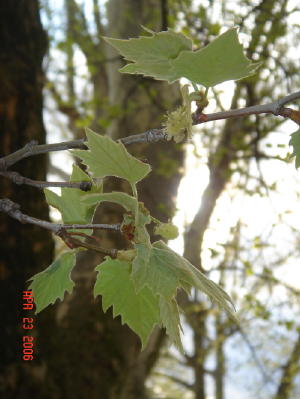
I love spring. I've always been grateful I was born at the beginning of the spring season. One of the things I miss most, living in a small city with relatively few trees, is the sheer volume of green I remember from earlier springs in other places. But even here, I remind myself, there's so much to see and rejoice in -- including the eight sycamores across the road. I took this photo a couple of weeks ago, when the leaves were still tender and new. They're already starting to take on a fuller, summery look now, but I think I like them best in this tiny, unfurling stage. They remind me to hope.
 My daughter loves the sycamores too. She likes to find small branches and twigs that have broken off them, which we call "syacmore wands." That's because she likes to play "sycamore fairy" and dance over to the tiny scrubby pine trees bordering the nearby parking lot (some small cedars and firs she's absolutely fascinated with, and has begun hugging each day). She takes her sycamore wand and gently touches the little trees in a gesture of beautiful benediction.
I really do love spring. My sprit's been feeling winter-weary for such a long time, in so many ways (and my body too). Thank God for new seasons, new growth, new life.
 My daughter loves the sycamores too. She likes to find small branches and twigs that have broken off them, which we call "syacmore wands." That's because she likes to play "sycamore fairy" and dance over to the tiny scrubby pine trees bordering the nearby parking lot (some small cedars and firs she's absolutely fascinated with, and has begun hugging each day). She takes her sycamore wand and gently touches the little trees in a gesture of beautiful benediction.
 I really do love spring. My sprit's been feeling winter-weary for such a long time, in so many ways (and my body too). Thank God for new seasons, new growth, new life.
Wednesday, May 03, 2006
Pause for Poetry
"There are days we live
as if death were nowhere
in the background; from joy
to joy to joy, from wing to wing,
from blossom to blossom to
impossible blossom, to sweet impossible blossom."
~Li-Young Lee, "From Blossoms"
I read this lovely poem this morning, and thought this stanza especially apt right now -- both during the heady, blossoming days of spring, and just for the juicy kernel of truth at the heart of these lines. We do all have days, I think, even in the midst of hardship, suffering, heartache, where we forget for a moment the hold that death has on our world, and we enter into interludes of joy that are so tangible and real that they cause heartache of another kind ("What a beautiful piece of heartache/this has all turned out to be" to quote Over the Rhine). I think it's in those moments of moving from "joy to joy," "wing to wing," and "blossom to...sweet impossible blossom" that we live in a heightened knowledge of the reality that death and decay do NOT, praise God, have the final world in our lives and in the created world. Perhaps it is when we are most attuned to the in-breaking Kingdom that the world becomes lit up with a kind of holy light that enables us to see and rejoice rightly, whatever our outward circumstances.
At least that's my story, and I'm sticking to it. :-)
as if death were nowhere
in the background; from joy
to joy to joy, from wing to wing,
from blossom to blossom to
impossible blossom, to sweet impossible blossom."
~Li-Young Lee, "From Blossoms"
I read this lovely poem this morning, and thought this stanza especially apt right now -- both during the heady, blossoming days of spring, and just for the juicy kernel of truth at the heart of these lines. We do all have days, I think, even in the midst of hardship, suffering, heartache, where we forget for a moment the hold that death has on our world, and we enter into interludes of joy that are so tangible and real that they cause heartache of another kind ("What a beautiful piece of heartache/this has all turned out to be" to quote Over the Rhine). I think it's in those moments of moving from "joy to joy," "wing to wing," and "blossom to...sweet impossible blossom" that we live in a heightened knowledge of the reality that death and decay do NOT, praise God, have the final world in our lives and in the created world. Perhaps it is when we are most attuned to the in-breaking Kingdom that the world becomes lit up with a kind of holy light that enables us to see and rejoice rightly, whatever our outward circumstances.
At least that's my story, and I'm sticking to it. :-)
Tuesday, April 25, 2006
Protesting the Da Vinci Code: Try an "Othercott"
My friend Janet Batchler, a Christian and screenwriter whose wonderful blog can be found at www.quoththemaven.blogspot.com, has come up with a very fruitful idea for letting Hollywood know exactly how you feel about the Da Vinci Code film being released in May. Rather than trying to explain it myself, I'll repost her post here -- she's given permission for folks to do that, as she wants the word spread!
Read on, and plan to go to the movies in May!
********
From Janet:
May 19th is the date the Da Vinci Code movie opens. A movie based on a book that wears its heresy and blasphemy as a badge of honor. What can we as Christians do in response to the release of this movie? I'm going to offer you the usual choices -- and a new one. Here are the usual suspects:A) We can ignore the movie. ........The problem with this option: The box office is a ballot box. The only people whose votes are counted are those who buy tickets. If you stay home, you have lost your chance to make your vote heard. You do nothing to shape the decision-making process regarding what movies will make it to the big screen.B) We can protest. ........The problem with this option: It doesn't work. Any publicity is good publicity, after all. Protests not only fuel the box office, they make all Christians look like idiots. And again, protests and boycotts do nothing to help shape the decisions being made right now about what movies Hollywood should make (or shape the decisions away from what we might prefer).C) We can discuss the movie. We can be rational and be ready with study guides and workshops and point-by-point refutations of the lies promulgated by the movie. ........The problem with this option: No one's listening. They think they know what we're going to say already. And once again, nothing changes if this is the response we opt for.But there's a fourth choice.On May 19th, you should go to the movies. Just go to another movie.Save the date now. May 19th, or May 20th. No later than Sunday, May 21st -- that's the day the ballot box closes. You'll get a vote, the only vote Hollywood recognizes: The power of cold hard cash laid down on a box office window on opening weekend.Use your vote. Don't throw it away. Vote for a movie other than DVC. If enough people do it, the powers that be will notice. They won't have a choice.Right now there's only one other studio movie scheduled for release, the DreamWorks animated feature Over the Hedge. Based on the early trailers, my kids already want to see it. Let's all go see it. (Or another just-opened movie of your choice, pending the final release schedules.) Let's rock the box office in a way no one expects -- without protests, without boycotts, without arguments, without rancor. Let's show up at the box office ballot box and cast our votes. And buy some popcorn, too.May 19th. Spread the word. Post this on your own blog, send it to friends on your e-mail lists. And let's all go to the movies.
********
Read on, and plan to go to the movies in May!
********
From Janet:
May 19th is the date the Da Vinci Code movie opens. A movie based on a book that wears its heresy and blasphemy as a badge of honor. What can we as Christians do in response to the release of this movie? I'm going to offer you the usual choices -- and a new one. Here are the usual suspects:A) We can ignore the movie. ........The problem with this option: The box office is a ballot box. The only people whose votes are counted are those who buy tickets. If you stay home, you have lost your chance to make your vote heard. You do nothing to shape the decision-making process regarding what movies will make it to the big screen.B) We can protest. ........The problem with this option: It doesn't work. Any publicity is good publicity, after all. Protests not only fuel the box office, they make all Christians look like idiots. And again, protests and boycotts do nothing to help shape the decisions being made right now about what movies Hollywood should make (or shape the decisions away from what we might prefer).C) We can discuss the movie. We can be rational and be ready with study guides and workshops and point-by-point refutations of the lies promulgated by the movie. ........The problem with this option: No one's listening. They think they know what we're going to say already. And once again, nothing changes if this is the response we opt for.But there's a fourth choice.On May 19th, you should go to the movies. Just go to another movie.Save the date now. May 19th, or May 20th. No later than Sunday, May 21st -- that's the day the ballot box closes. You'll get a vote, the only vote Hollywood recognizes: The power of cold hard cash laid down on a box office window on opening weekend.Use your vote. Don't throw it away. Vote for a movie other than DVC. If enough people do it, the powers that be will notice. They won't have a choice.Right now there's only one other studio movie scheduled for release, the DreamWorks animated feature Over the Hedge. Based on the early trailers, my kids already want to see it. Let's all go see it. (Or another just-opened movie of your choice, pending the final release schedules.) Let's rock the box office in a way no one expects -- without protests, without boycotts, without arguments, without rancor. Let's show up at the box office ballot box and cast our votes. And buy some popcorn, too.May 19th. Spread the word. Post this on your own blog, send it to friends on your e-mail lists. And let's all go to the movies.
********
Thursday, April 20, 2006
Reading Round-Up, Spring Cleaning Version!
ETA:This post started on April 20th, but I'm just now getting around to posting it on April 25th! (It's our fourteenth wedding anniversary, by the way.) :-)
Well, I've given up trying to do any sort of reading round-up for March...who can remember March? Both the end of last month and the beginning of this one are blurring for me, as I'm far too busy and frankly, exhausted. The past two weeks have been especially difficult: I've been sick with sinus/cough (and it's taken a definite turn for the worst in the past few days so I've had to go on antiobiotics); I've begun my new half-time job as parish administrator at our church (trying very hard to remember all my former secretary skills -- who knew that one could forget years of professional skills and habits so quickly?); my sweet daughter has been struggling with my new schedule and with less time with Mommy and has been acting out her stress through some difficult behavior, especially with her Daddy (and I miss my mornings with her soooo much); and oh yes, I left taxes to the last minute and had to spend several late nights fighting through the craziness of self-employment schedules, etc. Have I left anything out? Well, yes. :-) Those things I listed are just the "biggies" -- all sorts of other things still crowd my days as well, including paper grading, house cleaning, feeble attempts at writing.
I'm feeling a real need of prayer time, significant, real prayer time, rather than hurried prayers of blessing and petition as I run frantically hither and yon. Don't get me wrong: hurried prayers are a lifeline sometimes, and I'm thankful for them. But I need time with God, time to just rest in his presence, time to bring before him some of the hurts in my own heart as well as the hurts of others. After not quite two weeks as chuch administrator, I am already feeling somewhat pummelled by the depth and breadth of need here in our tired little town. More on that later perhaps.
So, with all this going on, have I had any time for reading? You bet. Some nights I'm so wound up after a far too long day, there's no way I can sleep without reading for a while first. And I've had some other moments here and there in the past month where I've been able to cram in reading. I'm doing a good bit of what I call "fluff" reading (helps me in that unwinding process) but I'm also dipping my toes into some more serious stuff. So here's a brief list of what I've been dabbling in book-wise in the past few weeks, though in no particular order:
Dorothy Simpson murder mysteries. Anyone out there know her? I discovered her at a library book sale (all paperbacks ten cents!) and have been absolutely delighted to discover a new Agatha Christie type writer, albeit a bit more contemporary. She's really good at English "cozy" mysteries -- my favorite of the mystery genre. I think she wrote mostly in the 1980s and 1990s (though for all I know she may still be at it) and I love her detective Inspector Luke Thanet. Thus far I've read two books: The Night She Died and Puppet for a Corpse. Very creative.
Jan Karon. I feel like I owe Ms. Karon an apology. I read the first two books of her "Mitford series" about ten years ago, and pretty much ever since then, whenever someone would ask me if I liked them, I added all kinds of qualifiers. "Yes, although they're not really great literature." "Yes, they're so comforting and downhome, I feel like I'm curling up with a copy of 'Southern Living'." "Yes, they're especially good, light reading for when you have the flu." That sort of thing. And...well, there's still some truth in those sentiments, I must confess. But having read through several more books in the series in the past few months (including A New Song, A Common Life and In This Mountain most recently) I have a newfound respect for Karon's narrative art. She manages to capture "slices of life" and very human personalities in poignant ways; she doesn't hesitate to write like people talk and frankly, to write about what real people talk about in the ways they really talk about it (including faith...and let's face it, we don't always talk about our faith profoundly) and she manages to provide her characters and readers with a real sense of hope. In times like ours, I think that's especially valuable. I also think she grew as a writer through the series. I was most impressed with her ability and willingness to have beloved, jovial Fr. Tim, the main character of the books, suffer through the throes of major depression in In This Mountain. Yes, he comes out on the other side (and you want him to!) but it's not cliched and pat at all. And I frankly love some of her minor characters, who remind me a bit of Lake Woebegoners. I'm especially fond of Emma Newland, Hope Winchester, and the regulars who eat breakfast at the Grill on weekday mornings.
And a sidenote: when I started reading Karon ten years ago, I knew almost no evangelical Episcopalians. For the past almost 9 years, I've lived, worked, and prayed with LOTS of them. So now I know just how good Karon is at capturing that particular ethos.
Yikes -- I started this post five days ago and have yet to either post it, or write fully about what I'm reading (I've just covered some of the fluff here!). This is getting way too long, so I'll go on and post. More soon on other things I'm reading by Marva Dawn and Rodney Clapp, among others.
Well, I've given up trying to do any sort of reading round-up for March...who can remember March? Both the end of last month and the beginning of this one are blurring for me, as I'm far too busy and frankly, exhausted. The past two weeks have been especially difficult: I've been sick with sinus/cough (and it's taken a definite turn for the worst in the past few days so I've had to go on antiobiotics); I've begun my new half-time job as parish administrator at our church (trying very hard to remember all my former secretary skills -- who knew that one could forget years of professional skills and habits so quickly?); my sweet daughter has been struggling with my new schedule and with less time with Mommy and has been acting out her stress through some difficult behavior, especially with her Daddy (and I miss my mornings with her soooo much); and oh yes, I left taxes to the last minute and had to spend several late nights fighting through the craziness of self-employment schedules, etc. Have I left anything out? Well, yes. :-) Those things I listed are just the "biggies" -- all sorts of other things still crowd my days as well, including paper grading, house cleaning, feeble attempts at writing.
I'm feeling a real need of prayer time, significant, real prayer time, rather than hurried prayers of blessing and petition as I run frantically hither and yon. Don't get me wrong: hurried prayers are a lifeline sometimes, and I'm thankful for them. But I need time with God, time to just rest in his presence, time to bring before him some of the hurts in my own heart as well as the hurts of others. After not quite two weeks as chuch administrator, I am already feeling somewhat pummelled by the depth and breadth of need here in our tired little town. More on that later perhaps.
So, with all this going on, have I had any time for reading? You bet. Some nights I'm so wound up after a far too long day, there's no way I can sleep without reading for a while first. And I've had some other moments here and there in the past month where I've been able to cram in reading. I'm doing a good bit of what I call "fluff" reading (helps me in that unwinding process) but I'm also dipping my toes into some more serious stuff. So here's a brief list of what I've been dabbling in book-wise in the past few weeks, though in no particular order:
Dorothy Simpson murder mysteries. Anyone out there know her? I discovered her at a library book sale (all paperbacks ten cents!) and have been absolutely delighted to discover a new Agatha Christie type writer, albeit a bit more contemporary. She's really good at English "cozy" mysteries -- my favorite of the mystery genre. I think she wrote mostly in the 1980s and 1990s (though for all I know she may still be at it) and I love her detective Inspector Luke Thanet. Thus far I've read two books: The Night She Died and Puppet for a Corpse. Very creative.
Jan Karon. I feel like I owe Ms. Karon an apology. I read the first two books of her "Mitford series" about ten years ago, and pretty much ever since then, whenever someone would ask me if I liked them, I added all kinds of qualifiers. "Yes, although they're not really great literature." "Yes, they're so comforting and downhome, I feel like I'm curling up with a copy of 'Southern Living'." "Yes, they're especially good, light reading for when you have the flu." That sort of thing. And...well, there's still some truth in those sentiments, I must confess. But having read through several more books in the series in the past few months (including A New Song, A Common Life and In This Mountain most recently) I have a newfound respect for Karon's narrative art. She manages to capture "slices of life" and very human personalities in poignant ways; she doesn't hesitate to write like people talk and frankly, to write about what real people talk about in the ways they really talk about it (including faith...and let's face it, we don't always talk about our faith profoundly) and she manages to provide her characters and readers with a real sense of hope. In times like ours, I think that's especially valuable. I also think she grew as a writer through the series. I was most impressed with her ability and willingness to have beloved, jovial Fr. Tim, the main character of the books, suffer through the throes of major depression in In This Mountain. Yes, he comes out on the other side (and you want him to!) but it's not cliched and pat at all. And I frankly love some of her minor characters, who remind me a bit of Lake Woebegoners. I'm especially fond of Emma Newland, Hope Winchester, and the regulars who eat breakfast at the Grill on weekday mornings.
And a sidenote: when I started reading Karon ten years ago, I knew almost no evangelical Episcopalians. For the past almost 9 years, I've lived, worked, and prayed with LOTS of them. So now I know just how good Karon is at capturing that particular ethos.
Yikes -- I started this post five days ago and have yet to either post it, or write fully about what I'm reading (I've just covered some of the fluff here!). This is getting way too long, so I'll go on and post. More soon on other things I'm reading by Marva Dawn and Rodney Clapp, among others.
Sunday, April 16, 2006
"Death and Darkness, Get You Packing...!"
Alleluia! The Lord is risen! He is risen indeed! Alleluia!
"Let no one grieve at his poverty, for the universal kingdom has been revealed. Let no one mourn that he has fallen again and again; for forgiveness has risen from the grave. Let no one fear death, for the Death of our Savior has set us free. He has destroyed it by enduring it.
—John Chrysostom, bishop of Constantinople; sermon, ca. 400
Death and darkness, get you packing,
Nothing now to man is lacking,
All your triumphs now are ended,
And what Adam marred is mended.
- Henry Vaughan (1621-1695)
Hail thee, festival day!
Blessed day to be hallowed forever;
Day when our Lord was raised,
Breaking the kingdom of death.
Lo, the fair beauty of the earth,
From the death of the winter arising!
Every good gift of the year
Now with its Master returns.
Rise from the grave now, O Lord,
The author of life and creation.
Treading the pathway of death,
New life You give to us all.
Hail thee, festival day!
Blessed day to be hallowed forever;
Day when our Lord was raised,
Breaking the kingdom of death.
--Fortunatus (530-609) translated by Maurice F. Bell
"Let no one grieve at his poverty, for the universal kingdom has been revealed. Let no one mourn that he has fallen again and again; for forgiveness has risen from the grave. Let no one fear death, for the Death of our Savior has set us free. He has destroyed it by enduring it.
—John Chrysostom, bishop of Constantinople; sermon, ca. 400
Death and darkness, get you packing,
Nothing now to man is lacking,
All your triumphs now are ended,
And what Adam marred is mended.
- Henry Vaughan (1621-1695)
Hail thee, festival day!
Blessed day to be hallowed forever;
Day when our Lord was raised,
Breaking the kingdom of death.
Lo, the fair beauty of the earth,
From the death of the winter arising!
Every good gift of the year
Now with its Master returns.
Rise from the grave now, O Lord,
The author of life and creation.
Treading the pathway of death,
New life You give to us all.
Hail thee, festival day!
Blessed day to be hallowed forever;
Day when our Lord was raised,
Breaking the kingdom of death.
--Fortunatus (530-609) translated by Maurice F. Bell
Saturday, April 15, 2006
The Day In Between
I decided to walk into the office this morning...no, not working (at least not officially) but I had agreed to proctor some exams for the sister of a friend, who is taking some extension courses through her university. The church offices on a Saturday provide a quiet place for her to take the tests, and it gave me a marvelous opportunity to walk a good, long walk on a beautiful spring day.
I was almost stunned by the beauty. Did spring really arrive overnight, or have I been so tired and stressed all week long that I just hadn't noticed it coming? The trees are in early golden flowered leaf (especially the maples), the birds are singing, and there are flowers and flowering trees, purples, pinks, whites, yellows, almost everywhere. It looked like Easter had come a day early! Except that two churches along my route both still had wooden crosses swathed in black, reminding me (with a beautiful poignancy, since they stood near flowering trees) that we're still experiencing the day "in between."
I don't think we in the church really know what to do always with the day "in between" Good Friday and Easter. At least not most of the churches of which I've been a part. It's something of a blank day. As we follow along in the Gospel story, Jesus has died and is not yet risen. The disciples are in the dark, literally (hiding in locked rooms) and spiritually.
Perhaps it's a day to enter into that darkness a little -- to know in our depths the sorrow that His closest friends and followers must have felt the day after the cross. To know in our depths what it cost God to win us back to himself, what it cost Jesus to redeem us from our subjection to evil and to death.
Maybe that's why we're given Psalm 88 in the morning lectionary. I've always found this to be one of the saddest Psalms -- there seems to be no real hope, not even at the end when so many Psalms (even of deepest, most harrowing complaints and pain) leap into a ringing affirmation (even Psalm 22 moves into a trust song).
Yet today, reading it again, I was struck by these questions the Psalmist cries out in verses 10-12: "Dost thou work wonders for the dead? Do the shades rise up to praise thee? [Selah] Is thy steadfast love declared in the grave, or thy faithfulness in Abaddon? Are thy wonders known in the darkness, or thy saving help in the land of forgetfulness?"
When I read these on most days, I either read them (sadly) as somewhat rhetorical questions, or (on my better days) as heartrending cries of a lonely and broken heart, but still a heart not expecting to hear an answer.
What we know from the joyous truth of the resurrection we celebrate tomorrow, however, is that there is a resounding answer to these questions. The answer is YES! Jesus is the great YES! God's vindication of His son as he raises Him to new life is a YES! YES, God works wonders for the dead! YES, the shades will one day rise up to praise thee (along with everything else in all creation!) YES, God's steadfast love is declared...even in the grave! YES, God's wonders are known in the darkness (even of our own hearts and lives, even at the foot of a cross, even in locked rooms where we hide)! YES, God's saving help is known even in the land of forgetfulness (which is where most of us live so much of the time)!
May we never ever forget, Lord, the love that took you to that cross. May we never cease to praise and thank you for that love. May we never cease to marvel at how close death and life, sorrow and joy, really are. May we worship and adore you as our scarred and risen King.
I was almost stunned by the beauty. Did spring really arrive overnight, or have I been so tired and stressed all week long that I just hadn't noticed it coming? The trees are in early golden flowered leaf (especially the maples), the birds are singing, and there are flowers and flowering trees, purples, pinks, whites, yellows, almost everywhere. It looked like Easter had come a day early! Except that two churches along my route both still had wooden crosses swathed in black, reminding me (with a beautiful poignancy, since they stood near flowering trees) that we're still experiencing the day "in between."
I don't think we in the church really know what to do always with the day "in between" Good Friday and Easter. At least not most of the churches of which I've been a part. It's something of a blank day. As we follow along in the Gospel story, Jesus has died and is not yet risen. The disciples are in the dark, literally (hiding in locked rooms) and spiritually.
Perhaps it's a day to enter into that darkness a little -- to know in our depths the sorrow that His closest friends and followers must have felt the day after the cross. To know in our depths what it cost God to win us back to himself, what it cost Jesus to redeem us from our subjection to evil and to death.
Maybe that's why we're given Psalm 88 in the morning lectionary. I've always found this to be one of the saddest Psalms -- there seems to be no real hope, not even at the end when so many Psalms (even of deepest, most harrowing complaints and pain) leap into a ringing affirmation (even Psalm 22 moves into a trust song).
Yet today, reading it again, I was struck by these questions the Psalmist cries out in verses 10-12: "Dost thou work wonders for the dead? Do the shades rise up to praise thee? [Selah] Is thy steadfast love declared in the grave, or thy faithfulness in Abaddon? Are thy wonders known in the darkness, or thy saving help in the land of forgetfulness?"
When I read these on most days, I either read them (sadly) as somewhat rhetorical questions, or (on my better days) as heartrending cries of a lonely and broken heart, but still a heart not expecting to hear an answer.
What we know from the joyous truth of the resurrection we celebrate tomorrow, however, is that there is a resounding answer to these questions. The answer is YES! Jesus is the great YES! God's vindication of His son as he raises Him to new life is a YES! YES, God works wonders for the dead! YES, the shades will one day rise up to praise thee (along with everything else in all creation!) YES, God's steadfast love is declared...even in the grave! YES, God's wonders are known in the darkness (even of our own hearts and lives, even at the foot of a cross, even in locked rooms where we hide)! YES, God's saving help is known even in the land of forgetfulness (which is where most of us live so much of the time)!
May we never ever forget, Lord, the love that took you to that cross. May we never cease to praise and thank you for that love. May we never cease to marvel at how close death and life, sorrow and joy, really are. May we worship and adore you as our scarred and risen King.
Friday, April 14, 2006
Why This Friday is so Good
"The other gods were strong; but Thou wast weak;
They rode, but Thou didst stumble to a throne;
But to our wounds only God’s wounds can speak,
And not a god has wounds, but Thou alone."
--Edward Shillito, from "Jesus of the Scars"
What a beautiful poem, and what a beautiful truth. And written by a man who knew the horrors of World War I and knew how badly indeed the world can wound us.
They rode, but Thou didst stumble to a throne;
But to our wounds only God’s wounds can speak,
And not a god has wounds, but Thou alone."
--Edward Shillito, from "Jesus of the Scars"
What a beautiful poem, and what a beautiful truth. And written by a man who knew the horrors of World War I and knew how badly indeed the world can wound us.
Friday, April 07, 2006
A few more poetry "life/lines"
More lines of poetry keep coming to me:
"Hope is the thing with feathers/that perches in the soul..."
"When despair for the world grows in me..."
"He counted every snowflake as it fell..."
"I shall arise and go now, and go to Innisfree"
"I took the road less traveled by and that has made all the difference"
"Love is not love which alters when it alteration finds"
"Little Lamb, who made thee?"
"I who have died am alive again today"
"Hope is the thing with feathers/that perches in the soul..."
"When despair for the world grows in me..."
"He counted every snowflake as it fell..."
"I shall arise and go now, and go to Innisfree"
"I took the road less traveled by and that has made all the difference"
"Love is not love which alters when it alteration finds"
"Little Lamb, who made thee?"
"I who have died am alive again today"
National Poetry Month
Tired from a too long day, I'm jangling
with bumblebuzz of Irish Breakfast tea...
yep! past midnight and I'm blogging again!
******
April may be "the cruelest month" but here's one lovely thing to remember: it's also National Poetry Month. Check out www.poets.org for all kinds of goodies.
I spent a few minutes on the site this evening, trying to unwind, and found out about a wonderful project called "Life/Lines." Poets and readers send in lines of poetry that mean something to them, lines they've suddenly recalled or that they've found lodged in their hearts for years. Brief reflections on why those certain lines of poetry stick with them are included. The project's ongoing -- apparently anyone can send in their favorite lines of poetry.
I'm too tired to think properly, but here are a few favorite lines that come to me now as I let my mind wander...(these are just as they come to me; I can't vouch for accuracy of punctuation or line breaks).
"Lord, send my roots rain."
"They also serve who only stand and wait." (This one was submitted by someone else on the site; it's long been a favorite of mine too.)
"Nature's first green is gold"
"Getting and spending we lay waste our powers"
"I shall be the gladdest thing under the sun!"
"I saw eternity the other night, like a great ring of pure and endless light"
"That never was America to me"
Interesting what pops up when you're tired! More soon...and I'll identify all poets later too (if anyone wants to guess or knows who they are, feel free!).
with bumblebuzz of Irish Breakfast tea...
yep! past midnight and I'm blogging again!
******
April may be "the cruelest month" but here's one lovely thing to remember: it's also National Poetry Month. Check out www.poets.org for all kinds of goodies.
I spent a few minutes on the site this evening, trying to unwind, and found out about a wonderful project called "Life/Lines." Poets and readers send in lines of poetry that mean something to them, lines they've suddenly recalled or that they've found lodged in their hearts for years. Brief reflections on why those certain lines of poetry stick with them are included. The project's ongoing -- apparently anyone can send in their favorite lines of poetry.
I'm too tired to think properly, but here are a few favorite lines that come to me now as I let my mind wander...(these are just as they come to me; I can't vouch for accuracy of punctuation or line breaks).
"Lord, send my roots rain."
"They also serve who only stand and wait." (This one was submitted by someone else on the site; it's long been a favorite of mine too.)
"Nature's first green is gold"
"Getting and spending we lay waste our powers"
"I shall be the gladdest thing under the sun!"
"I saw eternity the other night, like a great ring of pure and endless light"
"That never was America to me"
Interesting what pops up when you're tired! More soon...and I'll identify all poets later too (if anyone wants to guess or knows who they are, feel free!).
Wednesday, April 05, 2006
Bread and...Hyacinths!
This is just too wonderful and funny.
Just a few hours after I posted my long, rambling post below (see "Bread and Roses") I found this amazing little poem on another blog:
If of thy mortal goods thou art bereft,
And from thy slender store two loaves alone to thee are left,
Sell one, and with the dole
Buy hyacinths to feed thy soul.
- Saadi (a Persian poet)
Doesn't this just capture the heart of my ramblings?
By the way, it was posted at www.acircleofquiet.blogspot.com -- an absolutely lovely blog. I check it about 2-3 times a month. I don't know the woman who writes it; it's a treasure I found a few months ago, linking from the blog of a friend of a friend of a friend, I think. Although I don't know her, her site often blesses my life and provides me with moments of beauty (some of the "imagined roses" I mentioned before). Isn't it great...the internet can indeed be a means of transmitting good and gracious things!
Just a few hours after I posted my long, rambling post below (see "Bread and Roses") I found this amazing little poem on another blog:
If of thy mortal goods thou art bereft,
And from thy slender store two loaves alone to thee are left,
Sell one, and with the dole
Buy hyacinths to feed thy soul.
- Saadi (a Persian poet)
Doesn't this just capture the heart of my ramblings?
By the way, it was posted at www.acircleofquiet.blogspot.com -- an absolutely lovely blog. I check it about 2-3 times a month. I don't know the woman who writes it; it's a treasure I found a few months ago, linking from the blog of a friend of a friend of a friend, I think. Although I don't know her, her site often blesses my life and provides me with moments of beauty (some of the "imagined roses" I mentioned before). Isn't it great...the internet can indeed be a means of transmitting good and gracious things!
Tuesday, April 04, 2006
Bread and Roses
I usually write a "round-up" of the previous month during the first week of the new month, but frankly I've been too tired (and a bit too scatterbrained) to contemplate that posting. Maybe soon. Life is gearing up to be interesting for a while, as I'm taking on a new, half-time job outside the house. It's the first time I will have worked outside the home at all since Sarah was not quite 2 -- in other words, half her life ago. So we've all got big adjustments coming. I'm wishing I didn't have to do this, but I'm also grateful God is providing something for our family -- and I'm trying to be willing to do what needs to be done as he provides.
One of the adjustments I forsee is less time to read and write -- between new work hours during the day, continued work I need to do at night (both as a t.a. and in course development for the course I'll be teaching online next fall) and perhaps most importantly, trying to be as attentive and truly present as I can in the fewer waking hours I'll have with my little girl (not to mention regular "stuff" like ongoing household tasks and -- oh yes! eating! prayer! sleep!) I just can't see how I'm going to carve much of a slice out of that pie to dedicate to writing projects. Once again, I'm faced with the dilemma of having creative fire burning in my bones/longing to flesh out ideas into stories, poems and articles/wanting to use this gift and valuing the gift in and of itself -- and yet being forced to put it low, low on the priority list because it's not "productive" and doesn't help my family economically. I've been here many times in my life, but for some reason being faced with yet one more season of consciously having to push writing into the cracks and crevices of my life hurts a lot more this time around. Maybe because I just had a birthday so am feeling more aware of the swift passing of time. Maybe because the older I get, the more I feel I have to say and the more I long to find ways to say it through story. How ironic that the time periods of my life when I had more time and space to write, I didn't have nearly as much in me that longed to be written.
A week or so ago I read an interesting little book by Jill Paton Walsh, a short novel for middle grade readers called The Green Book. It's fantasy (and sort of rudimentary science fiction) about a family being sent with a small group of other people to colonize a new planet, since earth is dying. This family, a single dad and his three children, are told they must pack light. Each of them may bring one book and one book only. The father agonizes because he longs to bring a Complete Shakespeare but realizes that he needs to bring a book on technology instead, if he's going to help the colony in the new world. He lets each of his children make their own selection without his input, and their choices (and those of the other group members) are interesting, to say the least! When they all realize (after they're onboard the spaceship taking them to their new home) that the youngest child has brought along a blank book (the "green book" of the title) they're dismayed because they think she's made an unwise, even foolish choice. But it turns out to be a creative choice; one that the whole community values once they realize the child has been writing down the stories of the new community/colony. No one else had thought to do that.
I thought about entitling this posting "what book would you choose?" because I'm still genuinely curious to know what other people might pick if you could only pick one book in the world to take with you on a long journey without any real prospect of finding more books where you're arriving. I'm going to presuppose that you could take a Bible, or that the community would have a Bible; otherwise (for Christians at least) the question would be a "no brainer." What one book -- besides the Bible -- would you choose to take? I'm still not sure of my own answer. I think the Complete Shakespeare would be a good choice, actually, or the Complete Austen or the Complete Dickens. Although maybe the "complete" idea is a bit of a cop-out. Any takers here? I'd love to hear some ideas!
But the more I think about it, the aspect of Walsh's story that fascinates me most is that agonizing decision the Dad makes, to choose the "practical" book on technology (needed, productive) instead of the book that feeds the spirit in more intangible ways. How often we think of our more practical, physical needs first -- and I'm not saying that's a bad thing in and of itself, it's just a necessity because we're embodied, physical creatures. But we're so much more than just our bodies. It reminds me of that old workers' song "Bread and Roses" that talks of people's need for both bodily, physical sustenance and for beauty. How often do we have to choose bread and not roses in our daily existence? Most of the time, it seems to me. I also find myself painfully aware that, for a lot of people in our world, the choice between bread and roses isn't even a choice, because they don't have either one. And that should not be.
I know all this may sound a bit simplistic, but it's working on a soul level for me tonight. Bread and roses are more entertwined than we might think, because we human beings are entertwined, made up of body, mind, soul, spirit. Having really struggled with poverty in the past couple of years (although thankfully we've had family to help) one lesson I've learned is that poor people need and deserve good things and beauty as much as anyone else. So often what we give them is our castoffs, our broken and used things; our generic and less healthy food items go into the food pantry box, our faded and somewhat stained clothing goes to the vets, our toys with missing pieces go to the local children's home. Sometime again, when we're not counting every penny and still coming up short, I want to remember this lesson and give someone poor something that they need...on more than one level. Something beautiful as well as practical. Something new.
And as for now, I feel like I'm being asked to make a choice about how to apportion my time, and in some ways I'm having to weight that choice heavily toward practical considerations -- i.e. bread. Which means less time for roses. But I'll survive, and somehow I'll find some time in there somewhere for roses, real or imagined. At least that's my hope.
One of the adjustments I forsee is less time to read and write -- between new work hours during the day, continued work I need to do at night (both as a t.a. and in course development for the course I'll be teaching online next fall) and perhaps most importantly, trying to be as attentive and truly present as I can in the fewer waking hours I'll have with my little girl (not to mention regular "stuff" like ongoing household tasks and -- oh yes! eating! prayer! sleep!) I just can't see how I'm going to carve much of a slice out of that pie to dedicate to writing projects. Once again, I'm faced with the dilemma of having creative fire burning in my bones/longing to flesh out ideas into stories, poems and articles/wanting to use this gift and valuing the gift in and of itself -- and yet being forced to put it low, low on the priority list because it's not "productive" and doesn't help my family economically. I've been here many times in my life, but for some reason being faced with yet one more season of consciously having to push writing into the cracks and crevices of my life hurts a lot more this time around. Maybe because I just had a birthday so am feeling more aware of the swift passing of time. Maybe because the older I get, the more I feel I have to say and the more I long to find ways to say it through story. How ironic that the time periods of my life when I had more time and space to write, I didn't have nearly as much in me that longed to be written.
A week or so ago I read an interesting little book by Jill Paton Walsh, a short novel for middle grade readers called The Green Book. It's fantasy (and sort of rudimentary science fiction) about a family being sent with a small group of other people to colonize a new planet, since earth is dying. This family, a single dad and his three children, are told they must pack light. Each of them may bring one book and one book only. The father agonizes because he longs to bring a Complete Shakespeare but realizes that he needs to bring a book on technology instead, if he's going to help the colony in the new world. He lets each of his children make their own selection without his input, and their choices (and those of the other group members) are interesting, to say the least! When they all realize (after they're onboard the spaceship taking them to their new home) that the youngest child has brought along a blank book (the "green book" of the title) they're dismayed because they think she's made an unwise, even foolish choice. But it turns out to be a creative choice; one that the whole community values once they realize the child has been writing down the stories of the new community/colony. No one else had thought to do that.
I thought about entitling this posting "what book would you choose?" because I'm still genuinely curious to know what other people might pick if you could only pick one book in the world to take with you on a long journey without any real prospect of finding more books where you're arriving. I'm going to presuppose that you could take a Bible, or that the community would have a Bible; otherwise (for Christians at least) the question would be a "no brainer." What one book -- besides the Bible -- would you choose to take? I'm still not sure of my own answer. I think the Complete Shakespeare would be a good choice, actually, or the Complete Austen or the Complete Dickens. Although maybe the "complete" idea is a bit of a cop-out. Any takers here? I'd love to hear some ideas!
But the more I think about it, the aspect of Walsh's story that fascinates me most is that agonizing decision the Dad makes, to choose the "practical" book on technology (needed, productive) instead of the book that feeds the spirit in more intangible ways. How often we think of our more practical, physical needs first -- and I'm not saying that's a bad thing in and of itself, it's just a necessity because we're embodied, physical creatures. But we're so much more than just our bodies. It reminds me of that old workers' song "Bread and Roses" that talks of people's need for both bodily, physical sustenance and for beauty. How often do we have to choose bread and not roses in our daily existence? Most of the time, it seems to me. I also find myself painfully aware that, for a lot of people in our world, the choice between bread and roses isn't even a choice, because they don't have either one. And that should not be.
I know all this may sound a bit simplistic, but it's working on a soul level for me tonight. Bread and roses are more entertwined than we might think, because we human beings are entertwined, made up of body, mind, soul, spirit. Having really struggled with poverty in the past couple of years (although thankfully we've had family to help) one lesson I've learned is that poor people need and deserve good things and beauty as much as anyone else. So often what we give them is our castoffs, our broken and used things; our generic and less healthy food items go into the food pantry box, our faded and somewhat stained clothing goes to the vets, our toys with missing pieces go to the local children's home. Sometime again, when we're not counting every penny and still coming up short, I want to remember this lesson and give someone poor something that they need...on more than one level. Something beautiful as well as practical. Something new.
And as for now, I feel like I'm being asked to make a choice about how to apportion my time, and in some ways I'm having to weight that choice heavily toward practical considerations -- i.e. bread. Which means less time for roses. But I'll survive, and somehow I'll find some time in there somewhere for roses, real or imagined. At least that's my hope.
Monday, April 03, 2006
"The Weight of All My Dreams..."
I've not posted much this past week, and doubt I'll have much chance to in the coming week either. Having to let go of some things right now in a quest to survive and to not give in under the weight of some tremendous stress.
It's not quite Holy week yet, but I think God might be preparing me to walk a passion kind of road. It's hard.
Needing to flee to the life of Jesus. Needing to rest in his arms.
A pause for poetry in the midst of everything. This from W.B. Yeats.
Had I the heavens' embroidered cloths,
Enwrought with golden and silver light,
The blue and the dim and the dark cloths
Of night and light and the half-light,
I would spread the cloths under your feet:
But I, being poor, have only my dreams;
I have spread my dreams under your feet;
Tread softly because you tread on my dreams.
It's not quite Holy week yet, but I think God might be preparing me to walk a passion kind of road. It's hard.
Needing to flee to the life of Jesus. Needing to rest in his arms.
A pause for poetry in the midst of everything. This from W.B. Yeats.
Had I the heavens' embroidered cloths,
Enwrought with golden and silver light,
The blue and the dim and the dark cloths
Of night and light and the half-light,
I would spread the cloths under your feet:
But I, being poor, have only my dreams;
I have spread my dreams under your feet;
Tread softly because you tread on my dreams.
Monday, March 27, 2006
More on Story Shaping
I used the phrase "story shaping" the other day, and have been thinking about it a bit since. I really mean at least two things by the expression: how we shape stories (as writers and storytellers) and how stories shape us.
I've recently reaffirmed how much I prefer old-fashioned story shapes. That is, stories with some discernable linear progression (even if not completely straightforward), with transitions, connections and inner weavings that make sense, with solid beginnings and ends. By solid ends, I don't necessarily mean happy or tidy endings, but I don't like complete ambiguity either. And what completely drives me crazy is stories that really don't end...they just...stop.
So I'm an antiquated fish, completely at sea as I try to swim in and out of postmodern stories. I honestly appreciate some aspects of postmodern approaches to art: in particular, the way postmoderns don't mind "borrowing" from other places and times and finding new ways to "blend." Stories that can blend vintage sensibility with contemporary characterization and setting, for instance, I like very much.
But I'm getting a little tired of the postmodern celebration of "voices" in fiction. That is, creative and interesting voices that either have nothing truthtful or beautiful to say, or that don't say anything in a way that one can easily discern meaning.
Example: the other day I came upon a creative but frustrating short story titled "Notes to my Biographer" by Adam Haslett. Haslett was a bright star in the literary firmament a handful of years ago when he first got published (not sure what's he's been doing lately; I just happened to pick up his first short story collection) and had one of those writing pedigrees that it would be so easy to envy (studied at Yale, at Breadloaf, won major grants, stories picked up by NPR). "Notes to my Biographer" was apparently the story that garnered him first major attention, and I found it a fascinating read. Well-paced, distinct "voice," interesting characters, kept me turning pages. I think it was hailed as 'fresh' but it felt a bit trite to me, embodying familiar stuff of contemporary fiction -- including an unreliable narrator (strugging with mental illness...or was he?) with a gay son. A few pages from the end, I had to put the book back on the library shelf and didn't get back to it for a couple of days. I was curious enough about the ending to go back and finish it. And argh! It had one of those endings that drives me crazy. It didn't really end; it just stopped. And I can't help but feel that this was a well written vignette, an interesting sketch or slice of life, but not really a story -- at least not a story that feels shaped for any purpose beyond impressing me with its literary tricks. Somehow that doesn't feel like enough. Maybe I'm not being fair, since I often love poetry that seems to exist just to play with language, or to celebrate sound. But stories, though they can have those poetic elements, feel like a different category for me...
When I was not long out of college, I attended (by invitation) a two-week series of workshops at an intensive/low-residency MFA program that was considering inviting me to join the program. I took a lot of things away from the experience, not least the realization that as a relatively young woman (twenty-three) trying to find a way to articulate stories that connected with my faith, I was already an antiquated fish -- or at least an odd duck. :-) One clear memory I have from the two weeks was a one on one coversation I had with a very kind but clearly somewhat weary writing mentor, who kept trotting out good but tired advice about what I should be reading. She kept telling me I needed to "develop my own voice," and that until I did, my writing really wouldn't get anywhere.
It's not bad advice, though I have to admit in the past fifteen years, as I've grown and developed, my writing voice has changed and deepened right along with me. It's not a stagnant thing; its not as though I can reach a point where I think I've "arrived" in the development of my writing voice. I've also come to a place of some creative humility about the relative unimportance of my own distinct "voice" -- in part because I've come to recognize that my voice is simply responding to other voices in an ages-old conversation to which I am a pretty recent arrival. And in art but also on the larger levels of life and prayer, I am always in a position of response: responding to the one who first called me into being, and later called me out of darkness into his wonderful light. The Word spoke first, speaks first, always takes the initiative. He's the real Story-teller; I'm invited into the story (thanks be to God) and even invited to imitate his activity as Maker. Maybe I will always be hungering then to shape stories (with a small "s") that in some way reflect the ultimate (large "S") Story.
I've recently reaffirmed how much I prefer old-fashioned story shapes. That is, stories with some discernable linear progression (even if not completely straightforward), with transitions, connections and inner weavings that make sense, with solid beginnings and ends. By solid ends, I don't necessarily mean happy or tidy endings, but I don't like complete ambiguity either. And what completely drives me crazy is stories that really don't end...they just...stop.
So I'm an antiquated fish, completely at sea as I try to swim in and out of postmodern stories. I honestly appreciate some aspects of postmodern approaches to art: in particular, the way postmoderns don't mind "borrowing" from other places and times and finding new ways to "blend." Stories that can blend vintage sensibility with contemporary characterization and setting, for instance, I like very much.
But I'm getting a little tired of the postmodern celebration of "voices" in fiction. That is, creative and interesting voices that either have nothing truthtful or beautiful to say, or that don't say anything in a way that one can easily discern meaning.
Example: the other day I came upon a creative but frustrating short story titled "Notes to my Biographer" by Adam Haslett. Haslett was a bright star in the literary firmament a handful of years ago when he first got published (not sure what's he's been doing lately; I just happened to pick up his first short story collection) and had one of those writing pedigrees that it would be so easy to envy (studied at Yale, at Breadloaf, won major grants, stories picked up by NPR). "Notes to my Biographer" was apparently the story that garnered him first major attention, and I found it a fascinating read. Well-paced, distinct "voice," interesting characters, kept me turning pages. I think it was hailed as 'fresh' but it felt a bit trite to me, embodying familiar stuff of contemporary fiction -- including an unreliable narrator (strugging with mental illness...or was he?) with a gay son. A few pages from the end, I had to put the book back on the library shelf and didn't get back to it for a couple of days. I was curious enough about the ending to go back and finish it. And argh! It had one of those endings that drives me crazy. It didn't really end; it just stopped. And I can't help but feel that this was a well written vignette, an interesting sketch or slice of life, but not really a story -- at least not a story that feels shaped for any purpose beyond impressing me with its literary tricks. Somehow that doesn't feel like enough. Maybe I'm not being fair, since I often love poetry that seems to exist just to play with language, or to celebrate sound. But stories, though they can have those poetic elements, feel like a different category for me...
When I was not long out of college, I attended (by invitation) a two-week series of workshops at an intensive/low-residency MFA program that was considering inviting me to join the program. I took a lot of things away from the experience, not least the realization that as a relatively young woman (twenty-three) trying to find a way to articulate stories that connected with my faith, I was already an antiquated fish -- or at least an odd duck. :-) One clear memory I have from the two weeks was a one on one coversation I had with a very kind but clearly somewhat weary writing mentor, who kept trotting out good but tired advice about what I should be reading. She kept telling me I needed to "develop my own voice," and that until I did, my writing really wouldn't get anywhere.
It's not bad advice, though I have to admit in the past fifteen years, as I've grown and developed, my writing voice has changed and deepened right along with me. It's not a stagnant thing; its not as though I can reach a point where I think I've "arrived" in the development of my writing voice. I've also come to a place of some creative humility about the relative unimportance of my own distinct "voice" -- in part because I've come to recognize that my voice is simply responding to other voices in an ages-old conversation to which I am a pretty recent arrival. And in art but also on the larger levels of life and prayer, I am always in a position of response: responding to the one who first called me into being, and later called me out of darkness into his wonderful light. The Word spoke first, speaks first, always takes the initiative. He's the real Story-teller; I'm invited into the story (thanks be to God) and even invited to imitate his activity as Maker. Maybe I will always be hungering then to shape stories (with a small "s") that in some way reflect the ultimate (large "S") Story.
Subscribe to:
Posts (Atom)